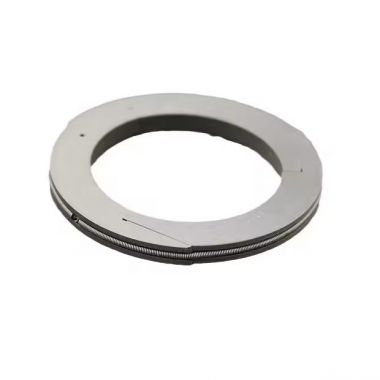


Description: The packing seal ring is installed inside the stuffing box cavity, hugging the reciprocating piston rod; it is the core wear-prone seal that blocks high-pressure hydrogen leakage, and several rings are grouped together to achieve multi-stage throttling sealing.
1. Throttling and pressure-reducing seal: By using several rings to reduce the hydrogen pressure stage by stage, the high-pressure hydrogen is restrained from leaking outwards along the piston rod, meeting explosion-proof safety requirements.
2. Adaptive gripping compensation: An outer ring spring keeps the seal ring against the piston rod surface, compensating for wear, rod runout, and eccentricity.
3. Zoned sealing: A radial ring and a tangential ring are assembled in pairs with their cuts staggered, eliminating a straight-through leakage path and blocking media escape.
4. Self-lubricating and friction-reducing: The material itself is lubricious, reducing friction and heat generation against the high-speed reciprocating piston rod.
5. Service isolation: Prevents high-pressure hydrogen from entering the crankcase lubricating oil side while blocking lubricating oil from entering the high-purity hydrogen process side, ensuring hydrogen purity.
The ring is an open, split, multi-segment assembly.
1. Graphite/carbon fiber filled PTFE: The most commonly used material in medium- and high-pressure hydrogen compressors; self-lubricating, resistant to hydrogen attack, and with a low coefficient of friction; suitable for oil-lubricated and oil-free models; operating temperature -40 to 200°C.
2. PEEK (polyetheretherketone): Preferred for high-pressure, high-temperature service.

 Contact Us