Description: Oil seal function: To prevent grease leakage and block dust, muddy water, and slurry from entering the bearing cavity, protecting the bearings of idlers, drums, and reducers; oil seal failure is the main cause of seized idlers and damaged drum bearings.
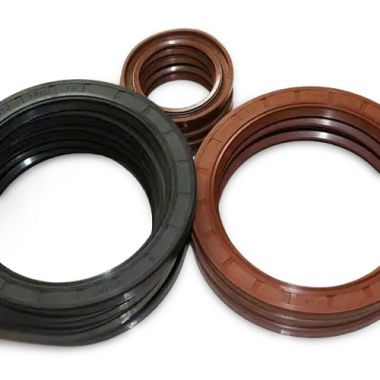
1. Skeleton oil seal (standard part): Metal skeleton (fixed support) + rubber lip + self-tightening spring; the spring makes the lip grip the shaft and form an oil film seal, used in drum bearing housings and reducer output shafts.
Idler combination seal (non-standard): Labyrinth seal (nylon/plastic non-contact the first barrier against dust and water) + rubber lip seal (contact type.
The second barrier); the two are assembled as a set inside the idler bearing housing, the mainstream design for maintenance-free idlers.
Materials
1. NBR (nitrile butadiene rubber, most commonly used): Resistant to grease and abrasion, 40–120°C; for mining, sand and gravel, and coal.
Not resistant to strong acids, alkalis, or high temperatures.
FKM fluororubber: High-temperature resistance and acid/alkali corrosion resistance; for clinker and high-temperature chemical service, at high cost.
HNBR (hydrogenated nitrile butadiene rubber): Better wear and heat resistance than NBR; used in heavy-duty, harsh mining applications.
Labyrinth housing: PA nylon, modified PP.
Metal skeleton: cold-rolled steel sheet.
Spring: Stainless steel, to stop corrosion and loss of elasticity.
Classification
1. By structural form1) Skeleton oil seal (single lip/double lip).
Single lip: Seals lubricant only.
Double lip: Main lip seals the oil and the secondary lip excludes dust; used in drum bearing housings, couplings, and reducer shaft ends.2) Idler labyrinth lip seal combination.
Single-stage labyrinth: For normal dry conditions. Multiple labyrinth + double-lip rubber seal: For coal mines, ports, and washed materials.
Strong water- and dust-exclusion capability; the mainstream idler configuration.3) Taconite seal: Dedicated to heavy-duty drum bearing housings.
Multiple labyrinth + oil seal design, greaseable, for high-dust mining environments. By Mode.
Contact oil seal: The lip fits tightly against the shaft, giving good dust and water exclusion, but it wears; skeleton oil seals and rubber lip seals.
Non-contact labyrinth seal: Frictionless and long-lived but it cannot be used alone and must be combined with a contact oil seal to block coarse dust particles and muddy water.
Scenarios
1. Idler rollers: All use a labyrinth + rubber lip seal combination; NBR for ordinary sand and gravel, FKM for chemical corrosion.
Idlers are grease-filled at the factory and are mostly maintenance-free. Drive/bend drum bearing housings: Double-lip skeleton oil seals, with Taconite seals in harsh conditions, and periodic greasing.
Reducers, fluid couplings, and couplings: Standard skeleton oil seals, to stop gear oil leakage.
By environment: NBR is sufficient for dry dust; water, water spray, and slurry require a multi-labyrinth + double-lip oil seal.
FKM for high-temperature clinker and chemical service. Problems and Failures
1. Lip wear and spring corrosion or breakage: Dust particles enter the lip and scratch the shaft surface.
The spring loses its grip, causing oil leakage and dust/water ingress, and the bearing quickly corrodes and seizes.
The idler stops rotating altogether and wears out the belt. Rubber aging and cracking: High temperature sunlight.
And media corrosion cause the rubber to harden and crack leading to complete seal failure. The labyrinth cavity is blocked by coal powder and sludge: The labyrinth gaps fill with material and lose their pressure-relief and mud-blocking function.
So muddy water is forced directly into the bearing cavity; this occurs frequently in damp mining areas.
Assembly issues: Burrs or sharp edges on the shaft scratch the oil seal lip during assembly; the oil seal is fitted off-center or with poor coaxiality, causing rapid localized overload wear on the lip.
Grease problems: Excessive grease expands when heated creating high internal pressure that pushes the oil seal lip open.
Causing oil leakage and dust ingress. Key points for operation and maintenance: Oil seals are wear-prone parts.
A damaged idler seal normally means replacing the whole idler whereas drum and reducer skeleton oil seals can be replaced individually.
Multi-labyrinth combination seals are preferred in wet, splashing conditions.



 Contact Us