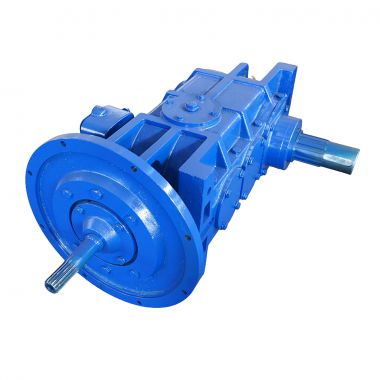
Description: A speed reducer lowers the motor speed and multiplies the output torque to drive the drum; it is the core drive component of a belt conveyor, taking high-speed input from the motor and delivering low-speed, high-torque output to drive the belt.
The speed reducer comprises a housing gear pair input shaft output shaft bearings oil seals oil level plug drain plug.
And breather cap. The motor is connected to the high-speed end of the reducer through a coupling or hydraulic coupling.
While the low-speed output shaft is connected to the drive drum.
Materials
1. Housing: Gray cast iron HT200-HT250, with good damping and casting properties; welded steel plate housings are also used for high-power units.
Gears and shafts: Gears are commonly made of 20Cr MnTi, carburized and quenched for wear resistance and impact resistance.
Shafts are made of 45# steel, or 40Cr quenched and tempered.
Bearings: self-aligning roller bearings, tapered roller bearings.
Seals: NBR skeleton oil seal; gaskets, O-rings.
Lubricating oil: Medium-load industrial gear oil.
Classification (Commonly used for conveyors)
1. ZSY/ZDY hard-tooth-surface cylindrical gear reducers: Two-stage and three-stage cylindrical gears.
The most common type for conveyors, with high load capacity and high efficiency; parallel-shaft arrangement. DBY/DCY bevel-cylindrical gear reducers: Vertically intersecting input and output.
The motor and drum are arranged at 90°, saving space; used in mining belt conveyors.
Planetary reducers: Small size and high torque, mostly used for small, mobile belt conveyors.
Cycloidal pinwheel: Mostly used for light-duty, low-power applications; rarely used on heavy-duty belts. Belt conveyors almost never use worm gears because their efficiency is too low.
Scenarios
1. ZSY hard-tooth-surface: For long-distance high-power fixed belt conveyors in sand and gravel power plants.
And ports. DCY bevel-cylindrical: For underground coal mines and mining sites where drive-station space is limited.
Planetary reduction: Mobile unloading cars and small movable belt conveyors. High-power configuration: Motor + hydraulic coupling + reducer + backstop + drive drum.
The backstop stop the loaded belt from slipping back when the machine stops. Faults and Problems
1. Oil leakage: Aging and wear of the oil seal.
A blocked breather cap raising internal pressure loose bolts or casting blowholes in the housing; oil leakage leads to oil starvation and burned gears.
Abnormal noise and high vibration: Gear pitting or broken teeth; damaged bearings; loose anchor bolts; poor alignment.
Insufficient gear oil. Excessive oil temperature and housing overheating: Insufficient lubricating oil or too high an oil level.
Deteriorated oil; damaged bearings; overload; poor heat dissipation; blocked breather cap. Gear pitting, wear, and broken teeth: Caused by long-term overload, poor lubrication, or dust and impurities in the oil.
This is major damage requiring overhaul or complete replacement.
Damaged bearings: Failed oil seals allowing water and dust ingress and causing lubrication failure; incorrect assembly clearance.
Input/output shaft breakage: Caused by impact loads, material blockage overload, or coupling misalignment. Key maintenance points: Regularly check oil level and quality.
Keep the breather cap clear; change the gear oil periodically; monitor vibration and temperature; deal with oil leaks promptly, because oil starvation can quickly ruin a reducer beyond repair.



 Contact Us