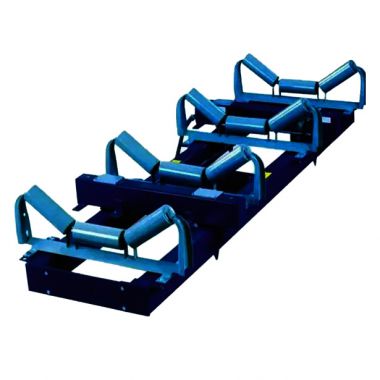


Description: The upper idler roller is installed on the material-carrying run of the belt. Its function is to support the conveyor belt and the material, reduce running resistance, and shape the belt into a trough to prevent material spillage. It is the most numerous wear-prone part on a conveyor.
Single idler roller: Roller (roller shell) + idler shaft + bearing housing + bearing + sealing assembly; a set generally consists of three rollers assembled on an idler bracket to form a trough idler set.
Roller (roller shell): It contacts the belt directly and bears friction and material pressure; bearing housings are press-fitted at both ends.
Idler shaft: Fixed and non-rotating, with both ends milled flat and clamped in the bracket slots.
Bearing: Deep groove ball bearing with C3 clearance; the roller rotates around the shaft; filled with lithium-based grease at the factory and mostly maintenance-free.
Sealing assembly: Labyrinth seal + rubber lip seal blocking dust and muddy water from entering the bearing cavity — the key to idler service life.
Bearing housing: Stamped or cast iron, welded or press-fitted to both ends of the roller to house the bearing and seals.
Trough angle: 35° and 45° are the mainstream angles; the larger the angle, the greater the load, but the higher the stress on the belt edge.
Materials1) Roller (roller shell). Q235/Q355 high-frequency welded pipe (carbon steel): The most general type, used in mining, sand and gravel, and coal.
Wall thickness 3–6mm; can be painted or galvanized for corrosion protection.
Polymer (PE/nylon): Lightweight, does not damage the belt, and corrosion-resistant; for chemical, light-load, and corrosive environments, but not for high-temperature or heavy-load service.
Ceramic/sprayed ceramic: Ultra wear-resistant, for mineral processing and highly abrasive slurry service, at high cost.
Stainless steel 304/316L: For food and acid/alkali corrosion service.2) Shaft: 45# cold-drawn round steel.
Bearing housing: stamped steel plate, cast iron.
Bearing: GCr15.
Seal: PA nylon labyrinth + NBR nitrile rubber lip seal. Subcategories of Upper Idler Rollers
1. Ordinary trough idler: The standard upper idler.
Used on most carrying sections of the machine.
Buffer idler: At the material loading point the roller shell carries rubber rings to cushion the impact of the material and shield the belt.
Trough self-aligning idler: Fitted with a swivel bracket to automatically correct belt misalignment.
Transition idlers: Near the head and tail pulleys where the trough angle changes gradually to reduce stress tearing at the belt edge.
Scenarios. Bulk material conveying for coal, sand and gravel, mines, ports, cement plants, chemicals, grain, and the like.
Spacing: Normally 1000–1500mm; reduced to 500–800mm at the loading section to limit belt deflection. Failure Modes Bearings may seize due to dust or water ingress, roller shells may wear through, and the pipe body may corrode.
An idler that does not rotate will quickly wear out the belt, making it a key wear-prone part for inspection.

 Contact Us