Description: The scraper is the core wear-prone part of a belt cleaner. It scrapes off material adhering to the belt surface, reducing material carry-back and spillage on the return run and reducing wear and failure of the idler rollers. It is a consumable that must be replaced regularly.
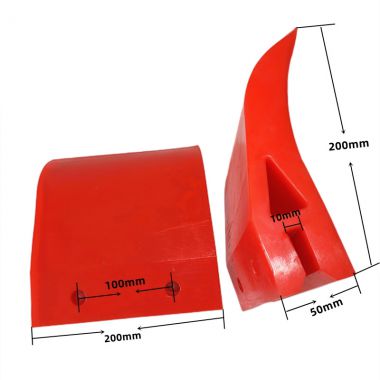
1. Blade body (scraper body): Directly contacts the belt to scrape off material; available in one-piece or segmented modular designs.
In the segmented design each segment is independent so local wear only requires replacing the individual segment rather than the whole scraper.
Clamping base: Pressure plate and bolts, fixing the scraper to the cleaner blade holder; alloy scrapers often have an elastic rubber base to allow slight retraction.
Matching tensioning mechanism: Spring or screw, providing the clamping force that keeps the blade edge against the belt.
Working contact angle: Generally an acute angle of 20–30° to the belt; it must not press perpendicularly against the belt.
Materials
1. Polyurethane (PU, most common): Shore hardness 80–90A, good elasticity, does not damage the belt.
Wear-resistant and acid/alkali resistant; temperature resistance ≤ 90°C; mostly used for primary cleaning. Service life 3–12 months.
Not for high-temperature materials.
Tungsten carbide: Extremely high hardness and wear resistance, and highly effective at scraping off caked or stubborn material.
Service life far longer than polyurethane; only for vulcanized-splice belts and strictly prohibited on mechanical belt fasteners.
Since improper adjustment easily scratches the belt; mostly used for secondary cleaning in heavy-duty mining and metallurgical applications.
Rubber scrapers: Low cost and good elasticity but poor wear resistance; now rarely used as the primary scraper and mostly used for cleaning the return run.
Ultra-high molecular weight polyethylene (UHMPE): Corrosion-resistant and non-stick; for light-duty chemical and food applications.
Ceramic cutter tips: Extremely wear-resistant, for wet material and slurry service; expensive, and classified as special spare parts.
Classification (by Installation Position/Function)
1. Primary (H-type) cleaning scraper: The first cleaning stage at the head pulley.
Preferably polyurethane removing most of the adhering material. Secondary (P-type) cleaning scraper: On the straight return run after primary cleaning.
Usually a segmented alloy scraper handling residual stubborn material. Reversible N-type scraper: For belts running in both directions.
The scraper is usable on both faces. Return-run O-type/V-type scraper: Installed on the non-working face of the belt to remove debris falling onto the inside and shield the tail pulley.
Usually a rubber or polyurethane V-shaped design. Scenarios. Coal mines, power plants, and cement plants: Primary polyurethane and secondary alloy scrapers used in combination.
Corrosive service in grain and chemical industries: Polyurethane, UHMPE. Highly abrasive ores in mines: Tungsten carbide scrapers.
High-temperature clinker: Special high-temperature-resistant alloy scrapers. Belt speed is generally ≤ 5m/s; the higher the belt speed, the faster the scraper wears.
Problems in 1. Incomplete cleaning and material carry-back on the return run: Rounded scraper blade edges or loose.
Failed clamping springs; insufficient pressure; incorrect installation angle; protruding belt splices; and belt misalignment causing localized missed areas.
Premature scraper wear: Clamping force set too high; highly abrasive material; a tilted support causing one-sided loading on the blade edge.
Scratched belt surface: Excessive pressure from the alloy scraper; a tilted support; a chipped alloy blade tip with sharp edges.
Using an alloy scraper on a mechanical belt fastener, which cuts the belt splice directly. Scraper breakage and chipping: Impact from large lumps of material.
Temperature above the material's temperature limit; excessive spring preload. Abnormal noise and vibration: Loose scraper or blade bounce.
Uneven height of the segmented blade blocks.
Maintenance tips: Scrapers are wear-prone parts and should be replaced promptly once worn; the clamping force should be just enough for the blade to touch the belt lightly — tighter is not better.
Alloy scrapers must not be used on belts with mechanical fasteners.



 Contact Us