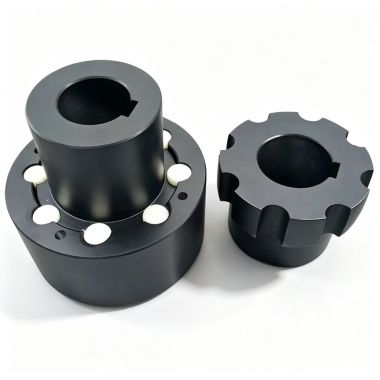
Description: Flexible pin couplings are a type of flexible coupling that relies on nylon pins to transmit torque. They have buffering and vibration reduction capabilities and can compensate for minor axial, radial, and angular misalignments between two shafts. They have a simple structure and are easy to maintain.
Materials
1. Half-coupling body: HT200 gray cast iron for general working conditions; 45# forged steel for heavy-duty and high-power applications.
Stainless steel for corrosive special operating conditions.
Elastic pin: Nylon (MC Nylon), the main elastic force transmission component.
Baffle: Carbon steel; stainless steel for corrosion-resistant environments. It consists of two half-couplings, nylon elastic pins, and baffles.
The two half-couplings are respectively mounted on the pump shaft and the motor shaft and torque is transmitted through the nylon pins inserted into the pin holes of the half-couplings.
The baffles stop the pins from coming out. The elasticity of the nylon pins themselves buffers vibration and compensates for minor installation deviations.
Classifications
1. HL type flexible pin coupling: standard type, universal for pump equipment. HLZ type flexible pin coupling with brake wheel: integrates brake wheel.
Matches brake motor and is mostly used in pump sets that require stop braking. Unlike elastic sleeve pins: it does not have a rubber elastic sleeve.
But relies on the deformation of the nylon pin itself to elasticity and its temperature resistance is better than that of rubber parts.
Specifications It is compatible with shaft diameters of φ20~φ120mm, and can be used with small to large power centrifugal pumps.
The applicable speed can reach up to 4000r/min, and it can withstand large torque.
Scenarios for: centrifugal pumps circulating pumps sewage pumps process pumps and applications with frequent start-stop cycles and some vibration.
Water supply and drainage, power plant auxiliary pumps, water treatment, and general chemical process pumps. Compared to rubber sleeves, it can be used in slightly higher temperature working environments.
Not for: large-angle centering deviation, strong impact load conditions; Nylon is not resistant to high temperature and is prone to aging and deformation in long-term high-temperature environments.
Points of 1. Nylon pins are consumable parts; they need to be replaced promptly if cracks or wear occur. The alignment of the two shafts must not exceed the allowable deviation.
Excessive deviation will accelerate the wear and breakage of the pins. The ambient temperature should not be too high to reduce rapid aging and failure of the nylon.



 Contact Us