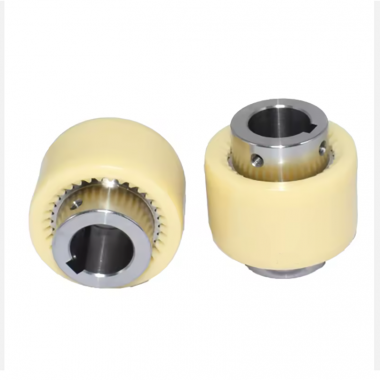
Description: Sleeve couplings are rigid couplings that rely on the fit between the sleeve and two shafts to transmit torque via keys or set screws. They are compact and small in size, and are used for connecting the pump shaft and motor shaft (or internal shaft sections).
Materials
1. Sleeve body: HT200 gray cast iron for general working conditions; 45# steel for heavy loads and higher speeds.
304 or 316 stainless steel for corrosive media conditions.
Flat key: 45# steel.
Set screw: ordinary carbon steel, stainless steel screw for corrosive environments. This coupling has no elastic elements.
Lacks buffering and shock absorption capabilities and can hardly compensate for misalignment. It mainly consists of three parts: a sleeve, a flat key (or spline), and a set screw.
The sleeve is an integral cylindrical part with its two ends respectively fitted onto the outer circumference of the pump shaft and the drive shaft.
Torque is transmitted through the flat key and the set screw presses against the shaft surface to axial positioning and stop the sleeve from moving axially.
Classifications
1. Keyed sleeve coupling: The sleeve and shaft are connected by a flat key which can bear a large torque and is the most commonly used in pump equipment.
Set screw sleeve coupling: It is locked by only the set screw has a small torque transmission capacity and is mostly used in small and micro pumps.
Split sleeve coupling: The sleeve is radially split, and the bolts tightly hold the shaft. Disassembly and assembly do not require moving the equipment at both ends, making maintenance convenient.
Specifications Based on the shaft diameter, pumps commonly use shaft diameters of φ6~φ60mm; small magnetic pumps and metering pumps often use φ12, φ16, φ20, φ24, φ28, φ32, φ38, and φ42mm.
These are generally used for pumps with low torque and small to medium power, with power mostly within tens of kilowatts.
Scenarios for: Small centrifugal pumps, magnetic pumps, metering pumps, and pipeline pumps; applications requiring high coaxiality, stable loads, and minimal speed fluctuations.
And installations in confined spaces.
Commonly used in: small water treatment pumps micro-process pumps in chemical plants laboratory pumps and small circulating pumps.
Not applicable: Conditions with impact loads, high vibration, or large coaxiality errors between the two shafts.
Cannot replace flexible couplings. Points of 1. High coaxiality is required during installation; large misalignment will cause wear on the shaft and bearings.
Screw-locking type is not for heavy loads and is prone to slippage and failure. Cast iron sleeves should be reduce in impact and high-temperature conditions.
Steel sleeves should be preferred.



 Contact Us