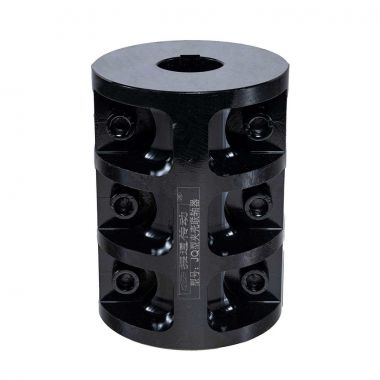
Description: Clamp couplings are rigid clamp-type couplings that rely on friction generated by the two halves of the clamp clamping the outer circumference of the shaft to transmit torque. Disassembly and assembly require no movement of the pump or motor, and no axial movement of the shaft, making them convenient. However, they lack elastic elements, have no cushioning or shock absorption, and offer almost no compensation for misalignment.
Materials
1. Jacket housing: HT200 gray cast iron for general working conditions; 45# forged steel for heavy loads and higher speeds.
304/316 stainless steel for corrosive environments.
Fastening bolts: Grade 8 carbon steel bolts for general working conditions; stainless steel bolts for corrosive environments.
It consists of the two clamp-housing halves, multiple sets of fastening bolts, and a flat key. The two halves fit together to enclose the pump shaft and drive shaft, and are secured by bolts.
The flat-key acts as auxiliary torque-transfer element and stop slippage. During disassembly and assembly, simply loosen the bolts and remove the housing directly.
The shafts do not need to move axially.
Classifications
1. Keyed clamp coupling: The shaft carries a flat key and the friction force plus the flat key work together to transmit torque.
Resulting in high torque which is the mainstream in the pump industry. Keyless clamping type clamp coupling: Torque is transmitted solely by clamping friction.
It has no keyway, does not weaken the shaft, and is for small to medium torque. Extended clamp coupling: A gap is left between the two shaft sections to facilitate the maintenance of the pump's seals.
Specifications Select the appropriate pump based on the shaft diameter; the commonly used shaft diameter is φ15~φ75mm.
It is mostly used in equipment with small to medium torque, and the suitable pump power is generally ≤55kW. Scenarios Small centrifugal pumps, mixing pumps, vertical pumps, small chemical pumps.
Applications requiring frequent maintenance and quick disassembly/assembly; units with limited installation space and where the shaft cannot move axially.
Used in water treatment, general chemical process pumps, and vertical circulating pumps.
Not for: working conditions with large impact loads, severe vibrations, and large coaxial deviations between the two shafts.
Not for high-speed, high-power pumps. Points of 1. High coaxiality of the two shafts is required; excessive misalignment will accelerate bearing wear.
Bolts must be tightened evenly diagonally; insufficient tightening torque will cause slippage. Cast iron housings are not for high-temperature or impact conditions.
45 steel housings are preferred for heavy loads.



 Contact Us