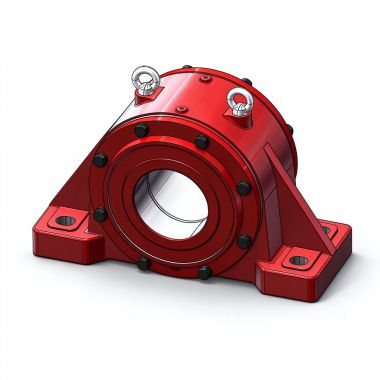
Description: Support base for main drive shafts. It bears radial loads from drums and materials, fixes bearing positions, and guarantees stable coaxial rotation of main-drive shaft and drum. It is a key supporting component for immersion-drum washing machines and operates under humid, silt-laden conditions.
Materials.
Housing body: HT200 grey cast iron (good vibration-damping performance and high rigidity; most common). 304 stainless-steel bearing housings are selected for humid-corrosive working conditions.
Stainless-steel is preferred for food-grade equipment to remove rust-driven material-contamination risk.
End caps or gland: Cast iron or 304 stainless-steel.
Sealing components: Housings are fitted with skeleton oil seals V-ring seals and dust covers mostly manufactured from food-grade EPDM rubber.
Fasteners: 304 stainless-steel bolts.
Matching bearings: Mostly UC-series pillow-block bearings. Stainless-steel ball bearings or bearings with waterproof rubber shields are selected for food-grade damp-condition units.
Categories By housing-body structure. P-type vertical bearing housing: Rectangular base secured to frame by anchor bolts.
Most common type for this equipment. F-type flange bearing housing: Direct mounting by square flange, suited for compact-layout units.
T-type slider-adjustable bearing housing: Center-distance fine-tuning capability for installation and centering correction.
Drum coaxiality calibration. By protective structure.
Standard type: Basic dustproof oilseal, for water-washing conditions with low silt-sand content. Double-sealed waterproo F-type: Inner-plus-outer oil seals together with dust baffles.
Recommended for immersion-drum washing machines, stop sewage and silt-sand ingress into bearing cavities.
By material: Cast-iron bearing housing, stainless-steel bearing housing. Uses
1. Bearing support: Bears radial loads from drum assembly and material weight.
Certain structures withstand minor axial forces. Positioning & alignment: Fix bearings and main-drive shaft to guarantee drum-rotation coaxiality and suppress vibration.
Bearing containment & protection: Provides bearing-mounting cavity isolates bearings from external sewage and silt and shield rolling elements.
Installation reference: Fastened onto equipment frames via anchor bolts; position can be fine-adjusted to correct drum levelness and coaxiality.
Auxiliary sealing: Cooperates with shaft-end oil seals and dust discs to build a sealing system blocking washing water ingress into bearing cavities.
Problems and Causes of Damage Faults. Sewage or silt-sand ingress inside bearing housing; housing-body cracking.
Loose anchor bolts; deformed sealing gland; bearing cavity corrosion; coaxial misalignment; vibration and abnormal noise during operation.
Bearing inner-ring seizure: the shaft rotates while the bearing housing stays stationary; housing bore wear resulting in outer-ring creep inside the housing bore.
Causes of Damage
1. Seal failure (most common): Oilseal aging flaking and wear permit dirt-sand ingress into bearing cavity.
Triggering bearing corrosion and seizure and imposing secondary damage to bearing housing.
Installation misalignment: Unequal height and large coaxial-deviation between left-right bearing housings generate alternating additional loads during operation.
Long-term stress cracks housings and loosens foundation bolts.
Overload impact: Material blockage or hard-object jamming inside drum generates instantaneous impact loads causing base cracking plus anchor bolt loosening or fracture.
Corrosion: Cast-iron bearing housings suffer surface corrosion from splashing water and fruit-vegetable organic acid.
Rust-layer expansion enlarges housing bore and creates outer-ring creep failure.
Fastener loosening: Anchor bolts gradually loosen under vibration; bearing housing shifts, drums run eccentrically and wear-vibration worsens.
Lubrication failure: Water ingress emulsifies grease and accelerates bearing damage and consequent bearing housing bore deterioration.
Routine Maintenance
1. Per-shift inspection: Inspect bearing housing for water leakage abnormal noise and excessive temperature rise.
Observe vibration level and material leakage conditions.
Seal inspection: Periodically inspect oil seals and dust baffles. Replace seals immediately upon leakage to reduce silt-sand ingress into bearing cavity.
Lubrication management: Fill food-grade grease according to specified cycles. If water intrudes, disassemble and clean bearing cavity and replace grease.
Never continue operation with emulsified grease. Tightening and alignment: Retighten anchor bolts weekly. Recalibrate coaxiality and levelness of both-side bearing housings after major equipment overhaul or drum or drive shaft replacement.
External anti-corrosion treatment: Periodically remove sludge from cast-iron bearing housing surfaces; derust and touchup paint for rusted zones.
Promptly clean residual fruit-vegetable juice off stainless-steel housings to stop pitting corrosion. Disassembly-inspection every 3 to 6 months: Remove end caps and inspect wear of bearings and housing bore.
Repair or replace bearing housing if outer-ring creep occurs. Long-shutdown protection: Clean sewage and residues off bearing housing surface.
Inspect seals and apply protective grease before long-term idle periods. Additional For immersion-drum washing machines, double-sealed waterproof stainless-steel bearing housings are preferred.
Bearing housings seldom fail directly. The vast majority of faults stem from seal failure and water ingress which first damages bearings.
Then bearing housings and finally the main drive shaft. Therefore periodic seal inspection is critically important.



 Contact Us