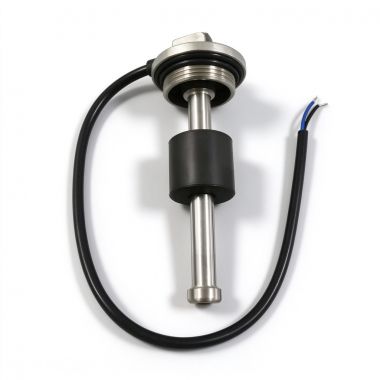
Description: Liquid level detecting element for soaking water tanks. Real-time monitoring of washing tank water level. Cooperates with the electronic control system to realize automatic water replenishment, overflow protection, low water level alarm and water shortage interlock shutdown. Prevents abnormal tank water level conditions from impairing washing or damaging bubble blowers and water pumps.
Materials. Water contact probe or float body: 304 stainless-steel; 316L stainless-steel for highly corrosive fruit-vegetable juice conditions.
Float housing: Food-grade PP plastic or PVDF (acid-alkali resistant).
Seals: Food-grade EPDM rubber, FKM fluoroelastomer.
Cable: Waterproof, oil-resistant food-grade sheathed cable. Ordinary carbon steel is strictly prohibited to reduce rust-induced material contamination and probe false signal triggering.
Categories
1. Float-type level switch (most widely used).
Small-cable float: Flexible installation, mainly used for high or low water level alarm. Linkage float-level switch: Stainless-steel linkage rod plus multiple floats.
Multipoint level setting (low level, normal level, high-overflow level).
Mainstream for food-washing equipment. Electrode-type liquid level sensor (electrode probe): Detects liquid level by means of water conductivity.
Multiple stainless-steel electrodes monitor different water levels. Simple construction.
Disadvantage: prone to scaling in silt-laden sewage, which causes false signal triggering. Submersible hydrostatic level transmitter: Submerged at tank bottom.
Outputs continuous analog water level signal for real-time touchscreen display. for automated production lines requiring continuous water level control.
Ultrasonic level gauge (non-contact): Mounted above water tank and does not touch liquid.
Drawback: Heavy bubble and water-mist interference inside tanks. Rarely applied for immersion bubble-washing machines.
Preferred selection for immersion-drum washing machines: linkage rod float level switch with strong anti-bubble-interference capability.
Uses
1. Low water level monitoring & interlock protection: Triggers alarm at insufficient water level and automatically stops bubble blowers and circulating pumps to stop dryrun burnout of equipment.
Automatic replenishment at normal water level: Water-replenishment valve opens automatically when water level drops to lower setpoint and closes upon reaching upper limit.
High level overflow alarm: Triggers alarm at abnormally high water level and closes inlet valve to stop tank overflow.
Equipment safety logic: Prohibits main-unit startup if water level fails to meet requirements and stabilizes material soaking-washing processes.
Problems and Causes of Damage Faults.
False alarms: Reporting water shortage with existing water, reporting water presence with no water; intermittent signals.
Controller fails to receive liquid level signals; float jamming; electrode scaling leading to false signal triggering.
Causes of Damage
1. Material residue and slime scaling (most common): Fruit-vegetable pectin and sludge adhere onto float or electrode surfaces.
Causing float jamming and electrode false signal triggering.
Mechanical impact: In-tank water-flow turbulence and material splashing impact float and linkage rod deforming rods or cracking floats with consequent water ingress.
Seal aging water ingress: Rubber seals at cable outlets age under long-term humid environment exposure; water seeps into the sensor and triggers short-circuit faults.
Corrosion: Long-term immersion in fruit-vegetable organic acid and alkaline detergent produces pitting corrosion on stainless-steel probes.
Plastic floats swell and age under detergent exposure.
Cable damage: High-pressure water impact and cable pulling during tank-cleaning-maintenance crack cable insulation and break conductors.
Bubble interference: Submersible or electrode-type sensors are susceptible to heavy-bubble disturbance leading to fluctuating liquid level signals.
Routine Maintenance
1. Per-shift inspection: Verify proper automatic water-level control performance; check whether floats move freely without jamming.
Per-shift cleaning: After shutdown and tank draining rinse floats linkage rods and electrode surfaces to remove fruit-vegetable residues and slime and stop scale buildup.
Weekly seal-and-cable inspection: Inspect sensor outlet seals and cable-sheath integrity; keep terminals dry against moisture oxidation.
Function test every 1 to 2 months: Manually simulate high and low water level conditions and confirm normal operation of alarm.
Water-replenishment and interlock-shutdown functions.
Fixture inspection: Check bracket tightness to stop float displacement induced by water-flow impact. Long-shutdown maintenance: Remove sensor for cleaning and drying during long-term downtime.
Clean heavy scale on electrodes or floats with soft brushes; do not scratch surfaces with hard implements. Spare-parts stock-up: Floats and sealing rings are wearing parts.
Keep spares on hand. Additional Bubble-washing tanks contain large volumes of bubbles plus fruit-vegetable residues.
Electrode-type sensors are not recommended due to high failure rate after scaling. Linkage rod floats deliver superior stability.
Component malfunction may appear merely as uncontrolled water level yet severe failures can burnout water pumps and trigger tank overflow.
Impacting the whole production line.



 Contact Us