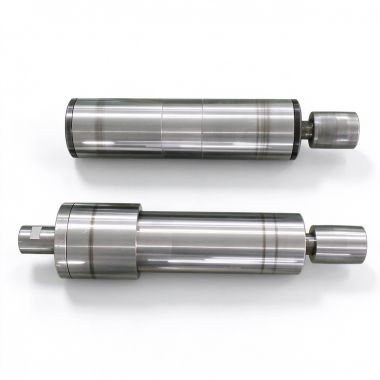
Description: Power transmission and load-bearing support component for drum assemblies. It connects the drive end and drum body, drives drum rotation, and withstands torque, radial material loads and alternating bending stresses. It is a critical force-bearing rotating part
Materials. Standard food processing conditions: Grade 45 carbon steel, heat-treated with hard-chrome plating. It has high substrate strength.
The chrome-plated layer provides rustproof and wear-resistant performance. It is the most widely used option for food-grade equipment.
For humid conditions or processing fruits and vegetables with weak-acid or salty media: 304 stainless steel. For highly corrosive environments, 316L stainless steel is recommended.
Solid shaft construction delivers high load-bearing capacity. Hollow stainless-steel shafts may be adopted for large-diameter long shafts to reduce self-weight.
Reinforcement shall be applied at welded flange joints. Categories By structural form. Integrated main drive shaft: Shaft head and shaft body are machined from a single blank.
Drum flanges are directly welded or bolted onto the shaft. High mechanical strength; mostly applied to small- and medium-size washing drums.
Segmented (flange-connected) shaft: Multiple shaft segments are assembled via flange connections. Easy disassembly and assembly.
For long, heavy-duty drums. By support arrangement. Single-end drive shaft: Motor reducer power output is provided only from one side.
The opposite side uses a driven short support shaft. Most widely adopted configuration. Dual-end drive shaft: Power input from both ends.
Heavy-duty high-capacity model with synchronous driving. By sealing-fit style. Shaft with shoulder for oil-water seal installation: Precision-machined journal matches shaft-end seals to stop water ingress into bearings.
Shoulderless simple shaft: Mainly used for roller-supported drums. The shaft only transmits torque and does not undertake radial loads.
Uses
1. Torque transmission: Transmit output power from the reducer to drive low-speed rotation of the drum.
Bearing support: Withstand radial loads generated by drum self-weight and material weight; maintain drum coaxiality and stop eccentric operation.
Positioning & installation: Mount bearing housings water seals and flanges on journal sections to fix the drum assembly and restrict axial displacement.
Sealing matching: Precision-machined journals cooperate with shaft-end water seals to block washing wastewater and sludge from entering bearing interiors.
Problems and Causes of Damage Faults. Journal wear and scoring (grooves formed at oil seal contact area resulting in water leakage).
Shaft bending deformation, drum eccentricity and excessive vibration. Peeling, rusting and pitting corrosion of shaft surface coating.
Fatigue cracks at shaft shoulder or flange root positions; shaft fracture under severe conditions. Deformed keyway from compressive loading, key roll out.
Power slippage so that the drum cannot be driven. Causes of Damage
1. Abrasion by sludge and sand: Seal failure allows sewage.
Sludge and sand to reach the journal continuously scratching the shaft surface. This is the most frequent failure mode.
Alternating-load fatigue: Long-term cyclic impact loading creates stress concentration at flange roots and generates fatigue cracks.
Overload impact: Sudden material blockage or hard jamming of the drum produces excessive instantaneous torque causing key shear.
Shaft bending or even shaft fracture.
Corrosion damage: Washing water containing salt and organic acids accelerates base metal corrosion once the chrome-plated layer fails.
Intergranular corrosion occurs at weld joints of stainless-steel shafts. Mis alignment during installation: Misalignment between bearing housing and reducer creates additional bending moment during operation and accelerates shaft bending and fatigue failure.
Bearing seizure: Water ingress seizes bearings. Forced operation bends the main drive shaft. Routine Maintenance
1. Per-shift inspection: Check shaft-end for water leakage and abnormal noise.
Observe rising operating vibration and periodic runout.
Seal inspection: Focus on oilseal or water-seal positions. Replace seals immediately upon leakage to reduce journal abrasion by dirt and sand.
Minor scoring on the journal can be repaired via thermal-spray coating; shafts with deep grooves shall be replaced.
Monthly coaxiality check: Inspect concentricity of drum rotation. Adjust mounting positions of bearing housing and reducer when vibration increases.
Anti-corrosion maintenance: Drain the water tank after shutdown and wipe water stains off shaft surfaces. Reapply protective coating for areas where chrome plating peels off to stop base material rusting.
Quarterly inspection for keys & connecting bolts: Check tightness of flat keys and shaft-flange bolts to stop key rollout.
Torque bolts for high-torque equipment to specified values. Prohibit forced startup: Clear material inside the drum after blockage occurs.
Never start under loaded conditions to reduce impact loads damaging the drive shaft. Periodic nondestructive testing (heavy-duty units): Visually inspect stress-concentration zones such as flange roots and shaft shoulders every 6 to 12 months.
Magnetic-particle inspection (MPI) on critical equipment to detect micro-cracks. Additional The cylindrical journal surface for seal-matching requires high-precision machining.
After journal wear, simple oilseal replacement will rapidly lead to repeated water leakage and high maintenance costs.
Periodic replacement of shaft-end water seals represents the most economical protection measure for the main drive shaft.



 Contact Us