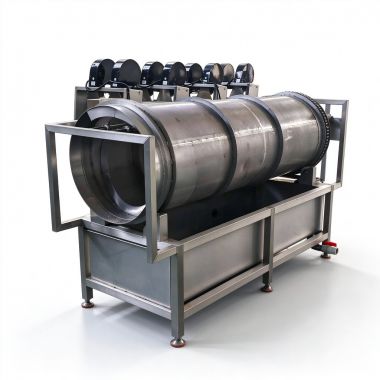
Description: Core working component for immersion-drum washing machines. Materials are soaked, tumbled and conveyed inside the drum to complete washing and desludging. It is a pressure-bearing rotating part in direct contact with materials and washing water.
Materials Mainstream material: 304 stainless steel (food-industry standard). 316L stainless steel is selected for demanding working conditions involving salt-containing or weakly acidic fruit-vegetable juice.
Cylinder perforated plate: Stainless-steel perforated plate or woven mesh. Internal spiral blades & lifting baffles: 304 stainless steel.
Local wear strips: Polyurethane (PU) or food-grade rubber (reduces material impact and abrasion).
End support flanges: 304 stainless-steel castings or plate-welded constructionLow-end units occasionally adopt 201 stainless-steel.
Which is prone to rust and practically prohibited for food processing applications. Categories By structural form.
Perforated-mesh cylinder type: Cylinder shell is covered with small holes. Soaking water flows freely in and out, while sludge and sand drain down to the lower water tank.
Most common for fruit-vegetable and root-crop washing. Closed cylinder with overflow openings: Seldom used; applied for light-duty washing where fine material leakage must be stop.
By conveying structure. Drum with built-in spiral blades: Continuously propels material from feed end to discharge end.
Standard configuration for continuous washing machines. Drum with lifting baffles: Enhances material tumbling and improves soaking-kneading performance.
May be combined with spiral blades. By mounting method. Two-end supported type (long-drum mainstream design): Supported by shaft ends and bearing housings on both sides.
Roller-supported type (large-diameter heavy-duty drum): Cylinder body rests on supporting rollers; both ends serve only for positioning.
Mainly used for high-yield root-tuber crop processing. Uses
1. Immerse materials inside the water tank for softening and loosening soil and impurities.
Low-speed drum rotation uses spiral blades and lifting baffles to tumble and rub materials for removing surface sludge and sand.
Cylinder mesh solid-liquid separation; sludge water passes through mesh openings and falls into the lower water tank.
Spiral construction continuously conveys materials and completes the workflow: feeding → washing → discharging.
Works together with bubble and spray systems to boost washing performance. Problems and Causes of Damage Faults.
Clogged mesh openings; deformed or torn mesh panels. Internal spiral blades with wear, cracks or detached due to weld-joint failure.
Corrosion-caused leakage at cylinder weld seams. Cracked weld seams at shaft-end flanges. Detached internal wear-resistant rubber strips.
Cylinder deformation, eccentric rotation and excessive vibration. Causes of Damage
1. Abrasive wear: Continuous friction by sludge.
Sand and stones against cylinder walls and spiral blades is the primary failure cause.
Corrosion: Long-term immersion in fruit-vegetable juice alkaline washing water and residual salt triggers preferential pitting corrosion along weld seams.
Mechanical overload: Sudden feed rate increase or hard-object (stone or metal) ingress causes deformation and weld detachment.
Stress concentration: Poor welding workmanship plus alternating operational loads produce weld cracking.
Bearing seizure: Seized support bearings with forced driving twist and deform the cylinder. Post-shutdown water accumulation: Residual water and silt retained inside the drum after shutdown accelerate corrosion.
Routine Maintenance
1. Per-shift cleaning: Rinse interior and exterior of the drum with clean water to remove silt and fruit-vegetable residues.
Reduce corrosion caused by residual fermentation; clear clogged mesh openings.
Inspection focus: Check for cracks on spiral blades and cylinder weld seams; inspect loose or detached wear-resistant rubber strips.
Observe eccentric rotation and abnormal noise. Monthly tightening check: Inspect internal fasteners and flange-connecting bolts to stop loose parts from falling into equipment.
Corrosion protection: Drain the water tank after cleaning and keep the drum dry; reduce prolonged use of high-concentration acid-alkali detergents.
Foreign-object protection: Install a stone-removal screen at the feed inlet to stop hard debris from impacting the drum body.
Flaw-detection every 3 to 6 months: Inspect weld seams and shaft-end flanges; repair minor cracks in advance by welding to stop sudden fracture.
Lubricate associated components: Periodically maintain shaft-end seals and bearing housings to stop bearing seizure and consequent drum assembly damage.
Supplementary Selection Points. For materials carrying large quantities of sand and gravel: Increase cylinder-plate thickness and fit PU wear-resistant lining strips.
For acidic fruits and vegetables (citrus fruits, tomatoes): Prioritize 316L stainless-steel. Drum rotating speed shall not be excessively high.
High speed aggravates drum wear and material impact damage.



 Contact Us