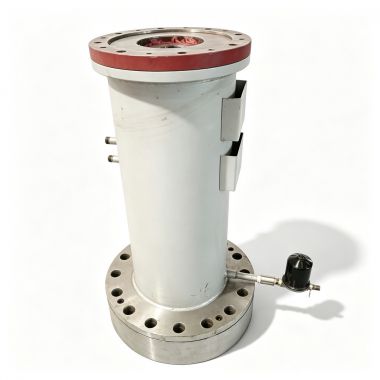


Description: The mainstream route to sorbitol is the high-pressure hydrogenation of glucose, a gas-liquid-solid three-phase high-pressure hydrogenation duty (hydrogen, glucose solution, and nickel-based catalyst). Hydrogen is flammable and explosive, so the reliability of the agitator seal is critical; industry generally uses a magnetically driven agitator on the vessel top, using static seals to eliminate the risk of hydrogen leakage from the shaft seal.
The complete magnetic drive unit consists of a motor-reducer, an outer magnetic rotor, an isolation sleeve, an inner magnetic rotor, a stirring shaft, and a bearing assembly. The whole unit is mounted on the reactor top flange and has no shaft-penetrating dynamic seal.
1. Motor + reducer: Explosion-proof motor, matched to hydrogenation operating speeds; large-capacity reactors are fitted with a hard-tooth-surface reducer.
2. Outer magnetic rotor: The external rotating part, made of neodymium-iron-boron permanent magnets and driven by the reducer.
3. Isolation sleeve (isolation cover): The core pressure-bearing sealing component; sorbitol hydrogenation commonly uses 316L or Hastelloy C-276, a non-magnetic thin-walled metal that withstands the high pressure inside the reactor, completely isolating the internal medium from the outside and allowing only the magnetic field to pass through.
4. Inner magnetic rotor: Located inside the isolation sleeve on the vessel side, it is a permanent magnet rigidly connected to the stirring shaft and follows the outer rotor synchronously by magnetic coupling.
5. Internal bearing: A sliding bearing lubricated by the medium itself, immersed in the sorbitol material.
6. Stirring shaft + impeller: Sorbitol hydrogenation is usually fitted with a hollow-shaft self-priming impeller that draws hydrogen from the vessel top into the liquid phase, intensifying gas-liquid-solid mass transfer and raising the hydrogenation conversion.
Overall sealing: The isolation sleeve and the reactor flange are sealed with a metal gasket static seal; there is no rotating dynamic sealing point, so hydrogen leakage is eliminated.
The motor drives the outer magnetic rotor → the rotating magnetic field penetrates the metal isolation sleeve → the field drives the inner magnetic rotor synchronously → driving the stirring shaft and self-priming impeller; power is transmitted across the gap by the magnetic field, with no mechanical contact between the inner and outer rotors.
1. Zero hydrogen leakage safety: Small high-pressure hydrogen molecules readily penetrate mechanical seals; magnetic drive is fully static-sealed, eliminating the risk of hydrogen escape and explosion at the source, and is the core safety feature of the sorbitol hydrogenation reactor.
2. Clean materials: No mechanical seal lubricating oil enters the reactor, ensuring the purity of the sorbitol product.
3. Compatible with three-phase stirring: It can be equipped with a hollow shaft self-aspirating stirrer to achieve hydrogen self-aspiration and catalyst suspension, thereby improving the efficiency of hydrogenation reaction.
4. Long cycle operation: No mechanical seal wear, reducing downtime due to frequent seal replacement, suitable for continuous sugar alcohol production.
Operating parameters for reference: Sorbitol hydrogenation commonly uses a design pressure of 5-9 MPa and a temperature of 120-180°C, with a glucose-sorbitol aqueous solution as the medium and a nickel-containing solid catalyst.
1. Isolation sleeve material: Hastelloy C-276 is preferred, followed by 316L, to resist media corrosion and eddy-current heating; ordinary carbon steel is strictly prohibited.
2. Magnet temperature resistance: Use high-temperature-resistant neodymium-iron-boron magnets to prevent demagnetization at the high hydrogenation temperature and avoid magnetic decoupling of the agitator.
3. Torque margin: The stirring load imposed by the solid nickel catalyst must be taken into account to prevent overload decoupling; large-volume (20-60 m³) magnetic drives require professional magnetic circuit design.
4. Internal bearings: Silicon carbide or cemented carbide sliding bearings, lubricated by the medium itself and resistant to catalyst particle wear; bearing temperature and isolation sleeve temperature monitoring must be provided.
5. Impeller matching: Magnetic drive + hollow self-priming impeller combination, with an additional propulsion impeller at the bottom to ensure the nickel catalyst stays suspended and the hydrogen is fully dispersed.
6. Safety interlock: Alarms for the isolation sleeve and inner bearing temperatures, with over-temperature interlock shutdown to prevent damage from eddy-current overheating of the isolation sleeve.

 Contact Us