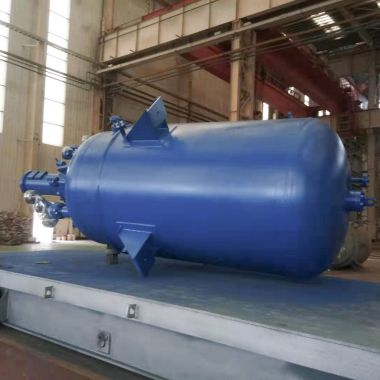


Description: The sorbitol hydrogenation reactor is a gas-liquid-solid three-phase high-pressure vessel in which an aqueous glucose solution is catalytically hydrogenated under high pressure over a Raney nickel or ruthenium catalyst to produce sorbitol. It is core hydrogenation equipment in the sugar alcohol industry, available as batch reactors (mainstream), semi-continuous, and continuous units.
Raw materials: 40-50% aqueous glucose solution, pH = 6-7, with a charge of 60-70% of the vessel volume
Catalysts: Raney nickel (mainstream), ruthenium-based catalysts
Operating temperature: 120-150°C
Operating pressure: 3.5-10 MPa, typically 4-7 MPa in industry
Reaction time: 1-3 h; endpoint: no further hydrogen absorption, residual sugar ≤ 0.5%
Operating procedure: N₂ displacement of air → H₂ displacement of nitrogen → heating and pressurizing → stirring and hydrogenation → cooling and depressurizing → discharging the material and separating the catalyst.
Vessel body and head
Pressure vessel with a large flange opening for easy maintenance and catalyst loading and unloading; nozzles include hydrogen inlet, feed, discharge, vent, sampling, and temperature and pressure measurement ports.
Sealing System (Top Priority)
Industry universally adopts magnetic coupling static seals with no mechanical seal, eliminating the risk of hydrogen leakage and explosion; essential for high-pressure hydrogenation.
Mixing System (determines production capacity)
The self-priming hollow-shaft impeller (specific to sorbitol reactors) draws hydrogen from the upper part of the vessel into the liquid phase, breaking it into fine bubbles and intensifying gas-liquid-solid mass transfer; an ordinary impeller gives low hydrogenation efficiency and a long reaction time.
Stirring speed: 80-220 r/min; explosion-proof variable-frequency motor, DIICT4.
Heat Exchange System
Jacket/half-pipe: Steam heating raises the temperature; cooling water is circulated to remove the strong heat of the hydrogenation reaction.
Some large reactors are fitted with internal cooling coils to control the temperature quickly and prevent runaway.
Discharge method: The material is discharged by the residual pressure in the vessel; catalyst settling and filtration connections can be provided at the bottom.
Safety interlocks: overpressure alarm interlock, overtemperature interlock, pressure transmitter, safety valve, rupture disc, hydrogen alarm.
Small and medium reactors: 316L (S31603) stainless steel
Large-scale industrial units (5-20 m³): Q345R + 316L clad steel plate (to reduce cost)
Special operating conditions: Hastelloy C276 can be selected for ruthenium catalyst service; ordinary carbon steel must not come into direct contact with the sugar solution.
| Item | Parameter range |
| Nominal volume | 500L-20m³ (commonly available in 3m³, 6m³, 10m³, and 20m³) |
| Design pressure | 8-12 MPa |
| Design temperature | 170-200°C |
| Sealed form | Magnetic static seal |
| Stirring | Hollow shaft self-priming propeller + auxiliary propeller |
| Heating and cooling | Jacketed steam + circulating water cooling |
| Motor | Explosion-proof frequency converter |

 Contact Us