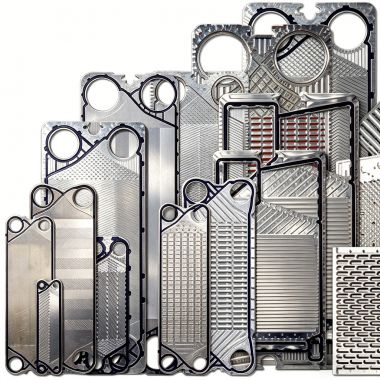

Description: The heat exchanger plates are the core heat transfer elements of a plate heat exchanger. Through their special corrugated structure and material, they achieve efficient heat exchange between hot and cold fluids, and directly determine the efficiency, pressure resistance, and corrosion resistance of the heat exchanger.
1. Efficient Heat Transfer: Serving as the inter-wall between hot and cold fluids, it quickly conducts heat through high thermal conductivity materials. The corrugated design greatly increases the effective heat exchange area (3-5 times larger than a flat plate) and forces fluids to form turbulence, disrupting the thermal resistance boundary layer, significantly enhancing the heat transfer coefficient.
2. Fluid Isolation: In conjunction with sealing gaskets, independent and sealed flow channels are formed between adjacent plates, ensuring that hot and cold media do not mix.
1. Plate Material: Extremely thin, typically 0.4–1.2 mm metal sheets.
2. Corner Holes: Holes at the four corners of the plate serve as fluid inlet and outlet channels, forming distribution and collection passages.
3. Sealing Grooves: Stamped grooves around the periphery for embedding sealing gaskets, defining the flow channel range.
4. Corrugations: Core feature, precisely stamped using molds, mainly including herringbone corrugations, horizontal straight corrugations, and inclined corrugations.
304 and 316L stainless steel

 Contact Us