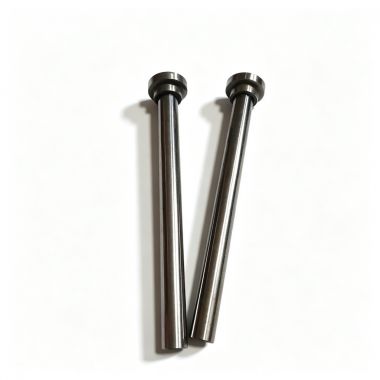
Description: It applies to reciprocating plunger pumps and high-pressure metering plunger pumps. The plunger is the core working part of the reciprocating motion, moving linearly to and fro inside the packing/sealing gland and forming a friction pair with the packing seal; it is a key wear-prone part. Diaphragm metering pumps have no plunger and rely on diaphragm transmission.
Function
1. The plunger reciprocates linearly inside the pump cylinder: retracting creates a negative pressure and draws in the medium.
While advancing compresses the medium to build high pressure and discharges it directly changing the pump chamber volume to convey the medium.
The outer cylindrical surface of the plunger mates with the packing (V-type packing gland packing) to form a dynamic seal.
Stop high-pressure medium from leaking outwards along the plunger. It withstands medium pressure reciprocating friction.
Medium corrosion and particle erosion and transmits the reciprocating thrust of the crosshead and connecting-rod mechanism.
The surface finish of the plunger determines the seal life; once the plunger is scored, a new packing seal will fail quickly.
Classification
1. By Form.
Solid plunger: The mainstream type for high-pressure reciprocating pumps; good rigidity and able to withstand high pressure.
Hollow plunger: Used in some high-flow, weight-saving designs, and relatively uncommon. By Surface Treatment (the Most Critical Classification).
Ceramic-sprayed plunger (alumina ceramic): The most widely used; high hardness, wear-resistant, and corrosion-resistant.
Zirconia ceramic-sprayed plunger: Better impact resistance than alumina, preferred for particle-laden service.
Cemented carbide hardfaced plunger: For high pressure and severe erosion. Hard chrome-plated plunger on a stainless steel base: Low cost, for ordinary low-pressure service.
Solid stainless steel plunger: Only for low-pressure corrosive service; poor wear resistance.
Commonly Used 1. Base material: 45# steel or 40Cr alloy steel (high pressure); 304/316L stainless steel (corrosive service).
Duplex steel. Surface working layer (determines service life).
Alumina ceramic: Good cost-effectiveness, wear-resistant, and corrosion-resistant; relatively brittle and must not be struck by hard objects.
Zirconia ceramic: Better toughness and resistance to particle impact, at a higher price. Cemented carbide hardfacing (WC): Erosion-resistant, for high-pressure, particle-laden service.
Hard chrome plating: 316L base with chrome plating, generally for low-pressure, clean media.
Key point: The plunger works through its surface coating and the base material does not itself take part in the friction seal.
Once the coating is damaged, the base is quickly corroded and worn. Problems and Fault Symptoms
1. Scoring grooving.
And scratches on the outer cylindrical surface: Particles trapped between the plunger and the packing scrape the surface.
External leakage increases sharply, and replacing the packing does not last long. Coating spalling and ceramic chipping: The ceramic layer cracks and pieces fall off.
The seal fails completely and material leakage is severe. Surface pitting and pinholes: After minor coating damage the base is corroded by the medium.
And the pits continually cut into the packing. Plunger bending and deformation: Overload, assembly deviation, or excessive lateral force.
The reciprocating motion jams, the packing wears rapidly on one side, and the pump becomes noisy. Damage to the end thread or connector: Improper assembly of the connecting rod or crosshead leads to stripped or broken threads.
Surface wear and roughening: Long-term friction reduces the surface finish and sharply shortens packing life. Causes of Damage
1. The medium contains solid particles: Particles enter the gap between the plunger and the packing and act like lapping paste.
Scoring the plunger surface — the main cause of field failures. Excessive packing gland force: When the packing is compressed too tightly.
Frictional heat rises aggravating plunger wear and heating and accelerating coating aging. Dry friction and insufficient lubrication: With no medium to lubricate and cool the packing.
It rubs dry against the plunger and the high temperature damages the surface coating.
Material selection mismatch: A chrome-plated plunger was chosen for a corrosive medium and the plating corroded through.
The ceramic grade was not impact-resistant and chipped. Poor assembly alignment: The crosshead connecting rod and plunger are not concentric.
So the plunger is subject to lateral force causing uneven wear and bending.
Medium corrosion: Minor coating defects allow corrosive media to penetrate causing pitting of the base material.
And the pits further damage the packing. Mechanical foreign-object impact: During maintenance and assembly impurities in the pipeline enter the stuffing box and hard objects strike the ceramic.
Causing chipping. Pressure overload shock: System water hammer and pressure surging; alternating stress accelerates fatigue cracking of the coating.
Points of Operation and Maintenance
1. Where the plunger shows obvious scoring ceramic chipping or pitting grinding it and putting it back into service is not recommended: even if it does not leak immediately.
It will rapidly consume new packing. When fitting new packing, the condition of the plunger surface must be checked.
If the plunger is damaged, replacing the packing alone will not cure the leakage. Key points for spare-part selection: Outside diameter, overall length, thread form, base material, and surface coating type.
Where the medium contains particles a filter should be installed upstream to reduce the entry of hard impurities into the stuffing box.
The packing gland should not be tightened excessively; a slight weep is acceptable for cooling and lubrication, whereas over-tightening will quickly burn out the plunger and packing.



 Contact Us