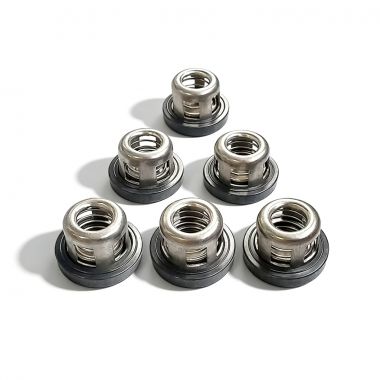
Description: A plunger pump has check valves at both the inlet and the outlet (suction valve and discharge valve), which are core wear-prone parts; the reciprocating plunger completes suction and discharge through the alternating opening and closing of the two valve sets. Diaphragm metering pumps and high-pressure reciprocating plunger pumps both use this arrangement. A check valve is generally supplied as a set: valve seat, valve plate or valve core, spring, and valve seal ring.
Function
1. Controlling the unidirectional flow of the medium: When the plunger retracts (liquid suction stroke).
The inlet valve opens and the outlet valve closes and the medium is drawn into the cylinder; when the plunger advances (liquid discharge stroke).
The outlet valve opens and the inlet valve closes and the medium is pressurized and discharged.stop backflow of medium: If the one-way valve seal fails.
The medium will flow back directly causing the pressure to not rise the flow to be insufficient and the output pulsation to intensify.
It can withstand reciprocating impacts, media pressure, particle erosion, and chemical corrosion. The working conditions of inlet valves and outlet valves are different: outlet valves are subjected to high system pressure.
Experience greater wear and impact and their lifespan is usually shorter than that of inlet valves.
Classification
1. By Valve Design. Ball-type check valve: The valve core is a solid ball; simple in structure, relatively tolerant of impurities, and easy to service.
Most commonly used in metering pumps and small and medium-pressure plunger pumps. Disc-type check valve: The valve core is a disc-shaped plate.
The sealing surface is large and well suited to high flow rates; it requires clean media, as particles easily jam the sealing surface.
Conical-core check valve: A conical valve core and conical seat give line contact sealing and good sealing in high-pressure service.
It requires clean media. By Assembly Method. Integrated valve assembly: The seat core spring and seal ring are pre-assembled as a set for direct replacement as a whole.
Making on-site maintenance quick.
Separate type: The seat, core, and spring are individual parts, so damaged parts can be replaced individually.
Commonly Used 1. Valve seat (sealing base)304/316L stainless steel: General chemical and water media; 2205 duplex stainless steel: Chloride-containing corrosive media.
Cemented carbide (tungsten carbide, WC): High-pressure, highly erosive particle service; wear-resistant and erosion-resistant.
PEEK: Mildly corrosive, particle-free service. Valve core (ball/valve disc) Ceramic balls (alumina/zirconia): The most commonly used type.
Wear-resistant and corrosion-resistant; high hardness, preferred for particle-laden service; brittle, and easily chipped by impact from hard objects.
Stainless steel balls: General service; not corrosion-resistant and prone to erosion. Cemented carbide balls: For high pressure and severe abrasion.
PTFE valve plates: For highly corrosive service, but not resistant to high pressure and easily deformed. Spring304 and 316 stainless steel.
Hastelloy C: For highly corrosive service. Spring stiffness determines the opening and closing response; a broken spring will directly cause valve failure.
Sealing Gaskets/O-ringsFKM fluororubber, EPDM, PTFE; select according to media compatibility. Problems and Phenomena
1. Erosion.
Pitting and grooving of the sealing surface: The sealing pair no longer closes tightly and the medium flows back.
The pump cannot build pressure, the flow rate is low, and the pressure fluctuates widely. Valve jamming (stuck valve core): Particulate impurities lodge between the valve core and seat.
So the valve cannot close or open fully; the pressure drops abruptly and pulsation becomes severe. Spring fatigue fracture and loss of elasticity: The valve core fails to return fully and the check valve closes late.
Backflow increases and the output pressure becomes unstable. Shattered valve core (ceramic ball): Impact or a blow from a hard object breaks the ball.
The pump cannot build pressure at all. O-ring and gasket aging or damage: Internal leakage from the valve assembly and cross-flow of the medium.
Loose valve seat threads: Vibration and impact cause the valve seat to loosen, leading to leakage.
Main causes of damage
1. Medium containing solid particles: Particles repeatedly strike the sealing surface causing erosion and pitting.
Particles lodging in the sealing surface cause valve jamming — the most frequent field failure. Pressure shock and water hammer: The reciprocating plunger itself produces pulsation.
And repeated water hammer impacts on the valve core and seat accelerate spring fatigue and sealing surface damage.
The discharge valve takes the high-pressure shocks and is therefore more likely to fail.
Chemical corrosion: Mismatched material selection leads to corrosion pitting on the valve seat valve core and spring.
Damaging the sealing surface. Improper spring selection: Too stiff a spring gives high opening and closing resistance.
Too soft a spring gives an insufficient closing response and increased backflow; long-term alternating loads cause fatigue fracture of the spring.
Medium crystallization and scaling: Crystals deposit on the sealing surface and stop the valve from closing; commonly seen with salt-type materials.
Cavitation and air binding: Insufficient pump suction causes gas-liquid mixing in the chamber and the collapse of the bubbles causes cavitation damage to the sealing surface.
Foreign objects entering the pump head: Welding slag or pipeline debris enters and directly strikes and shatters the ceramic valve core.
Points of Operation and Maintenance
1. For a check valve fault inspect the complete set first: valve seat valve core.
Spring and seals; replacing only the valve core will still leak if the seat already has erosion pits. For high-pressure, particle-laden service, cemented carbide valve seats with zirconia ceramic balls are preferred.
Inlet and outlet valves work under different conditions and have different service lives; do not interchange them.
Where the medium contains particles fitting a filter upstream is recommended to reduce the chance of valve jamming.for spare parts: Valve type and size.
Valve core material spring material and stiffness and O-ring material.



 Contact Us