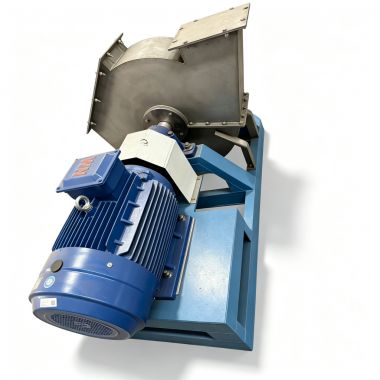


Description: The starch drying lift (also called a lift feeder or dispersing lifter) is the core feeding and dispersing equipment in a starch flash-air drying system. It is designed specifically to handle caked wet starch filter cake, breaking up the wet material and throwing it into the hot air drying duct to prevent pipe blockage and caking, ensuring instant flash drying.
Screw feeding section: A forced screw feeder with agitation, preventing wet starch from bridging or blocking, with variable-frequency speed control of the feed rate.
Impeller throwing and dispersing mechanism: A high-speed rotating paddle or impeller that breaks clumped wet starch into fine particles; this is the core working component.
Housing: Parts in contact with the material are generally 304 stainless steel, food grade, wear-resistant, and corrosion-resistant.
Drive system: Two motor-reducer sets, driving the feed screw and the dispersing impeller respectively.
Connections: The feed inlet receives wet starch from the dewatering machine; the discharge outlet connects to the flash drying duct; the side connects to the hot air duct.
Dehydrated wet starch (35-40% moisture filter cake) is force-fed into the lift chamber by the screw feeder; the high-speed impeller breaks up the clumped wet starch and reduces it to fine particles; at the same time, under the negative pressure of the system's hot air, the material is thrown into the drying duct; the fine starch particles are suspended and carried by the hot air stream, completing flash drying within seconds before entering the cyclone separator for collection of the dry starch.
Key function: Breaks up wet starch clumps, prevents large lumps from entering the drying duct, settling, and blocking it, increases the contact area between material and hot air, improves drying efficiency, and prevents starch gelatinization.
III. Process Support (Complete Airflow Drying Process)
Wet starch → Lift feeder → Hot air drying duct → Cyclone separator → Airlock discharge → Finished starch (moisture 12-14%); the exhaust gas is dedusted and discharged.
1. Breaks up caked filter cake, solving the problem of wet starch clumping;
2. Variable-frequency feed-rate control, adapting to different capacities and feed moisture contents;
3. Fully enclosed and operating under negative pressure, with minimal dust leakage;
4. Food-grade stainless steel, meeting the hygiene requirements of starch production;
5. The high-speed impeller is prone to wear and requires periodic inspection of the paddles; excessive moisture easily causes sticking to the walls and clogging.
Material blockage: The wet starch moisture is too high, the screw feed is too fast, or the impeller is worn so that the material is not broken up. Remedy: Reduce the feed rate, repair the impeller, and control the discharge moisture of the upstream dewatering machine.
High vibration and abnormal noise: Impeller wear imbalance, hard foreign objects entering, or bearing damage.
Clumps in the discharged material: The paddles are worn and dispersing capacity has dropped; the impeller paddles must be replaced.
Airflow-drying feed and dispersion of filter cake materials such as corn starch, cassava starch, potato starch, wheat starch, and vital wheat gluten.

 Contact Us