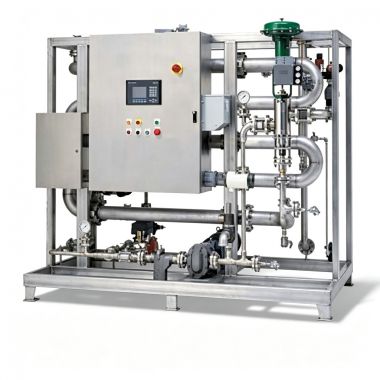


Description: Corn starch liquefaction equipment is used in the production of starch sugar, alcohol, monosodium glutamate, citric acid, and the like. High-temperature-resistant α-amylase is used to gelatinize and degrade corn starch granules into dextrin, reducing the viscosity of the mash and preparing it for subsequent saccharification or fermentation. The mainstream configuration is the continuous jet liquefaction system (most commonly used in industry).
Mixing tank (ingredient tank): 304/316L stainless steel, with agitation, inline pH measurement, and an enzyme dosing port; corn starch and process water are mixed into starch milk with a dry matter content of 30-32%; the pH is adjusted to 5.6-6.2 with sodium carbonate, and calcium ions and high-temperature-resistant α-amylase are added.
Starch milk transfer pump: A heavy-slurry centrifugal pump, temperature-resistant, ensuring stable feed pressure; an inlet strainer prevents debris from blocking the jet nozzle.
The most critical equipment in the whole liquefaction process; it consists of a nozzle, a steam chamber, and a mixing and diffusion section. High-pressure steam contacts the starch milk directly and instantaneously, gelatinizing it in a flash with a heat transfer efficiency approaching 100%.
Processing capacity: 0.5-300 m³/h; material 304/316L;
Process temperature: 105-110°C for the first injection; up to 140-160°C for the second injection to inactivate residual enzymes;
Advantages: Thorough gelatinization, no localized overheating, and continuous production. Disadvantages: The nozzle is prone to scaling and blockage and requires periodic cleaning.
A pressurized holding tank after the jet, in which the material resides for 2-5 minutes to ensure the starch granules are fully ruptured and gelatinized.
The material is depressurized and flash-evaporated to remove surplus steam and cool rapidly to 92-98°C; the heat of the secondary steam is recovered; after flashing, the mash enters the laminar-flow equipment.
Gravity plug flow, first in first out, with no agitation; the enzyme liquefaction reaction is completed by holding at 90-98°C for 90-120 minutes; the conical bottom allows precipitated protein impurities to be drained periodically; one unit or several in series may be used.
Control indicators: No blue colour on iodine testing, and a DE value of 8-12, indicate a qualified liquefied mash.
Steam system: stabilized steam source;
Online instruments: temperature, pressure, pH, flow rate;
Enzyme inactivation unit: Adjust pH to 4.2 or 4.5 to terminate α-amylase activity;
CIP cleaning system;
Heat exchanger: Recovery of waste heat from the flash steam.

 Contact Us