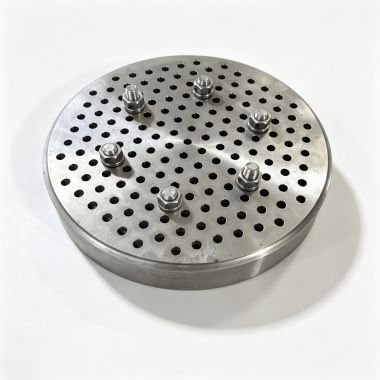


Description: A component of the twelve-stage hydrocyclone, core equipment in corn starch production.
The twelve-stage hydrocyclone fixing plate, also called the orifice plate, locating plate, or overflow/underflow fixing plate, is the core internal component of the starch twelve-stage hydrocyclone. It consists of an upper fixing plate (overflow orifice plate) and a lower fixing plate (underflow orifice plate); a large number of hydrocyclone tubes (10 mm/15 mm) are clamped between the two plates, dividing the shell cavity into three independent chambers: the feed chamber, the overflow chamber, and the underflow chamber.
Positioning and fixing the hydrocyclone tubes: The plate has an array of holes, and the two ends of each hydrocyclone tube seat in the holes of the upper and lower plates respectively, keeping all tubes coaxial and true, and preventing displacement from vibration during operation.
Chamber isolation and sealing: Separates the feed, overflow, and underflow chambers to prevent cross-flow of medium between process stages; once the orifice plate seal fails, it directly causes poor washing performance and failed starch-protein separation.
Pressure bearing: Withstands the high pressure of starch milk (working pressure generally 0.6-1.0 MPa), supports the weight of all the hydrocyclone tubes, and resists material erosion.
Plate body: Circular (to suit the hydrocyclone shell), with the outer diameter determined by unit specification (240, 300, 350, 400 types);
Plate holes: An array of round holes, with diameters matching the outer diameter of the hydrocyclone tubes and spacing that ensures installation clearance; bolt holes are provided on the outer ring for assembly and fixing to the shell and support columns;
Sealing: Each hole is fitted with a sealing ring, and the tube end is pressed tight to seal, preventing slurry from leaking through the hole clearance.
Food-grade 304 stainless steel (for ordinary starch service); plate thickness is generally 10-16 mm;
316L stainless steel is selected for corrosive service;
A few use polyurethane linings to improve erosion and wear resistance.
Note: The fixing plate is not a wear-prone part, but the hole sealing rings are. Long-term high-pressure scouring causes erosion wear at the hole openings and deformation of the plate; once deformed, the hydrocyclone tubes cannot be seated properly, causing material bypassing and reduced washing efficiency.
Orifice plate deformation: Excessive feed pressure or water hammer arches the plate face, so the hydrocyclone tubes are not clamped tightly and material leaks;
Hole erosion and wear: The hole openings enlarge, the seal fails, slurry crosses between chambers, and the protein content of the finished starch rises;
Sealing ring aging: Media cross over and process pressures fluctuate abnormally at each stage.
During strip-down inspection, check whether the plate face is warped or deformed; if flatness is out of tolerance it must be straightened or replaced;
Inspect the inner wall of every mounting hole for erosion;
Replace all hole sealing rings whenever the hydrocyclone tubes are changed;
Assembly must ensure that the two fixing plates are parallel and that the hydrocyclone tubes are neither loose nor skewed.

 Contact Us