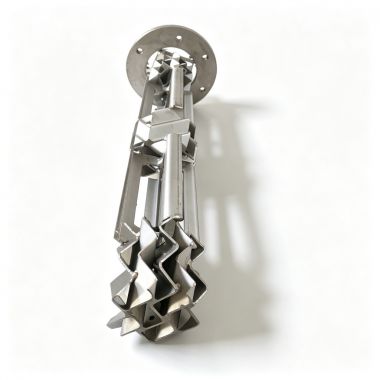


Description: Used for continuous inline mixing, reaction, pH adjustment, chemical dosing, and color adjustment of syrups, and widely used in corn sugar plants, cane sugar plants, and beverage syrup production lines.
Under pump pressure, the syrup flows through the internal spiral or plate elements, where the fluid is split, rotated, transposed, and recombined. The flow repeatedly turns left and right, pushing material from the center toward the pipe wall and from the pipe wall toward the center, achieving thorough radial mixing. No motor-driven stirring is required; mixing is accomplished by the fluid's own pressure, at the cost of a certain pressure drop. In laminar flow (high-viscosity syrup): splitting, displacement, and recombination. In turbulent flow (dilute sugar juice), eddy shearing is superimposed, so mixing is faster.
1. Cylinder: 304/316L stainless steel (mandatory for sugar production, resisting sugar liquor corrosion and meeting food hygiene requirements); connections by quick-release clamp or flange, for easy disassembly and CIP (clean-in-place) cleaning.
2. Internal Mixing Elements
◦ SK type (spiral twisted element): The most common type, suitable for syrups and sugar juice, and for mixing in laminar flow and medium- to high-viscosity syrups;
◦ SV/SX type: Suitable for turbulent dilute sugar juice and for chemical dosing and neutralization;
3. Jacket option: For cooling or insulating high-concentration syrup and preventing syrup crystallization from blocking the pipe.
Sugar media are prone to crystallization, so the element channels must not be too narrow, to prevent sucrose crystallization from causing blockage.
1. No moving parts, no shaft seal leakage, virtually maintenance-free;
2. Pipeline installation, continuous production, and minimal footprint;
3. Rapid, uniform mixing shortens the reaction residence time, reduces localized over-alkalization of the sugar juice, and limits sugar decomposition;
4. Supports CIP cleaning, meeting food hygiene requirements;
Main Disadvantages
A pressure loss is incurred; where the medium contains a large amount of crystalline particles, the flow channel must be enlarged in selection to prevent blockage.
1. Medium: sugar juice/syrup, Brix, viscosity, temperature;
2. Throughput; allowable pressure drop;
3. Operating conditions: Laminar or turbulent flow; whether calcium carbonate filter mud or sugar crystals are present;
4. Interface: Food-grade clamp/flange; whether jacketed insulation is required;
5. Number of elements: The more elements, the better the mixing, but the greater the pressure drop.
1. Install in the direction of the arrow on the housing; do not install in reverse; leave straight pipe runs upstream and downstream.
2. Reagents (lime slurry, acid) should be injected into the pipeline upstream of the mixer wherever possible;
3. The sugar solution is prone to crystallization; flush with water after shutdown to prevent sucrose crystallization from blocking the element gaps;
4. A marked increase in pressure drop indicates internal scaling or crystallization, and the unit must be dismantled and cleaned.

 Contact Us