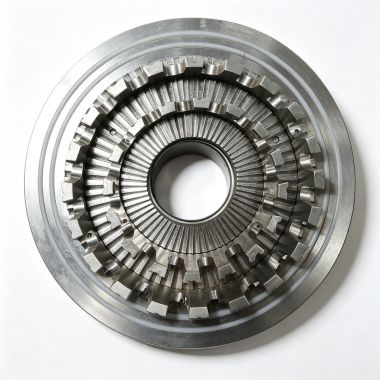


Description: The disc face carries radial crushing teeth, with coarse crushing teeth on the inner ring and fine grinding teeth on the outer ring. Material is fed from the center and progressively sheared and ground outwards. The gap between the moving and stationary discs determines the fineness of the finished product and can be adjusted manually. It is widely used for micro-powdering of rice protein, chemicals, and traditional Chinese medicine.
The material enters the center of the two grinding discs. The moving disc rotates at high speed while the stationary disc is fixed. The material is subjected to shearing, impact, and friction between the tooth grooves. The fineness of the powder is controlled by adjusting the gap between the moving and stationary discs. Qualified fine powder is discharged with the airflow, while coarse particles continue to be ground.
| Material | Features | Applicable Scenarios |
| Alloy tool steels DC53 and Cr12MoV | High hardness, wear-resistant, and can be repaired and reused. | Grain, chemicals, and common ores |
| 304/316 stainless steel | Hygienic and rust-proof, but with average wear resistance. | Food and pharmaceutical raw materials |
| Tungsten carbide cemented carbide | Extremely wear-resistant, but expensive. | High-hardness minerals, high-wear conditions |
| Zirconia ceramics | No metal contamination, brittle | Laboratory, high-purity materials |
Phenomena Requiring Replacement or Re-grinding
Production has dropped noticeably and the powder becomes coarser at the same settings, and adjusting the gap cannot improve it.
The tooth edges of the disc are worn flat, with deep grooves, broken teeth, or cracks
Increased machine current, increased abnormal noise, and severe overheating
The steel grinding disc can be removed and its tooth surface repaired and reused after wear; if the teeth are broken, it should be scrapped and replaced.
The grinding discs must be concentric, and the screws must be tightened evenly in a diagonal pattern; do not apply force on one side.
After assembly, perform an idle running test: reduce the gap until slight contact occurs, and check whether the friction marks are uniform around the entire circumference; the absence of friction marks in some areas indicates a lack of concentricity, requiring recalibration.
It is strictly forbidden to run the grinding disc directly against itself for a long time without material, as this can easily damage the tooth surface.
Disassemble and clean the grinding disc tooth grooves each time the material is changed, to prevent material residue from caking.
Regularly check and tighten the bolts to prevent them from loosening or shifting.
When processing hard materials containing impurities, install iron removal at the front end to prevent iron debris from breaking the grinding disc teeth.
Choose water-cooled grinding discs for high-temperature service, to reduce thermal deformation of the discs and extend their service life.

 Contact Us