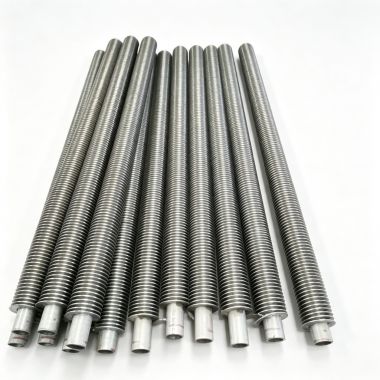


Description: The starch drying finned heat exchanger is an air-heated finned tube heat exchanger and is the core equipment of the hot air system in starch production lines (airflow drying, flash drying, tube bundle drying). The heat medium (steam/thermal oil/hot water) flows inside the tubes, while the process air is heated outside the tubes to provide clean hot air for starch drying.
Principle High-temperature heat transfer medium (saturated steam heat transfer oil hot water) is introduced into the finned tube base.
And the heat is to the outer fins through the tube wall; the fan drives cold air to horizontally wash the finned tube bundle.
The air absorbs heat and heats up generating high-temperature hot air which is sent into the starch drying host to remove the starch moisture and complete the drying process.
Common hot air temperatures in starch processing are 80–140°C and common steam pressures are 4–0.8MPa.1. Finned tube bundle (core): base tube + outer fins.
Rolled/high-frequency welded finned tubes are preferred and the fin spacing should be adapted to starch dust conditions.
Manifold/steam distribution box: Heat medium distribution and condensate collection; reliable steam trapping is essential in steam service.
Frame shell: Flange connection to hot air duct, sealed to stop air leakage.
Medium connections: Steam inlet/condensate outlet; heat transfer oil inlet and return ports. Considerations for Starch Drying Process Selection (Important) When drying starch.
Fine starch dust will be carried in the air which can easily accumulate and clog the fins. Therefore, the parameters of ordinary drying heat exchangers cannot be directly applied.
Material Selection. Food-grade starch production line: The base tubes and fins are both made of 304 stainless steel.
Meeting food hygiene requirements and resisting moisture and water vapor corrosion; aluminum fins are not recommended.
Because aluminum oxidizes and powders easily in the humid starch environment and contaminates the product. Ordinary industrial starch with a limited budget: 20# seamless steel pipe + steel fins, with a hot-dip galvanized housing.
Chloride ions or corrosive water vapor present: Upgrade to 316L. Fin Type and Fin Spacing.
Fin type: High-frequency welded finned tubes and rolled finned tubes are preferred; wound-on fins are not for dusty environments and are prone to powder accumulation and loosening.
Fin spacing: 4–6mm (2–3mm for ordinary clean air); for starch dust the spacing must be increased to stop clogging and facilitate blowing-down and cleaning.
Number of tube rows: 3–6 rows; staggered arrangement gives high heat exchange efficiency but slightly higher air resistance.
Heat Transfer Medium Compatibility. Saturated steam (most commonly used in starch plants): pressure ≤ 8MPa; a steam trap + bypass must be provided to drain condensate promptly and reduce water hammer and heat exchange degradation.
Heat transfer oil: For hot air conditions above 140°C, with the oil temperature controlled at ≤ 240°C.
Hot water: Used in low-temperature drying processes. Reference Process Parameters. Heat transfer coefficient: 30–55 W/(m²·°C).
Hot air temperature: 80–140°C. Allowable air volume: Matched to the air volume of the starch drying host, with a calculated windward face velocity of 5–2.5m/s.
Too low a velocity easily accumulates powder, while too high a velocity increases air resistance.

 Contact Us