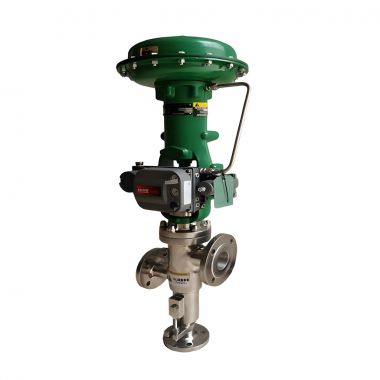

Description: Commonly used for corn/cassava/tuber starch milk, it is the core equipment for starch syrup and fermentation raw material liquefaction.
1. Starch Slurry Feeding Chamber: Lateral slurry intake, stable flow and pressure, evenly fed into the central nozzle channel.
2. Adjustable Needle Valve Conical Nozzle: Core component; needle valve adjusts up and down, changing the nozzle annular gap opening, controlling the film thickness and flow rate of the material.
3. Annular Steam Jacket with Steam Holes: Steam surrounds the nozzle, multiple turns of angled small holes spray steam at high speed, cutting the slurry 360°.
4. High-Strength Mixing and Shearing Chamber: Conical contraction chamber generating high-speed turbulence and strong shear fields.
5. Diffusion Outlet Pipe: Pressure reduction and flow stabilization, preventing flash evaporation, uniformly feeding into the liquefaction holding tank/laminar flow tube.
Auxiliary: Steam control valve, temperature probe, actuator (manual/pneumatic automatic temperature control).
1. Film Formation: Starch slurry pressurized by pump is extruded through the annular narrow gap between the needle valve and nozzle, forming a uniform thin material film.
2. High-Speed Steam Cutting: Saturated steam at 0.4–0.7 MPa is ejected at high speed through angled holes around the nozzle, instantly penetrating and cutting the material film.
3. Instant Heat Exchange and Strong Shear: The latent heat of steam is 100% released, raising the material fluid to 100–110°C within seconds; microturbulence in the chamber strongly disperses starch granules, destroys starch crystallinity, complete gelatinization occurs, while α-amylase evenly contacts the substrate to achieve rapid liquefaction.
4. Stable Pressure Transport: The diffusion tube decelerates and stabilizes pressure, preventing local overheating and clumping, with the outflow entering the insulation holding section to complete the liquefaction holding reaction.
Temperature Control: By adjusting the needle valve stroke → changing the steam flow cross-section, fine-tuning the steam amount, stabilizing the outlet liquefaction temperature.
Liquefaction Advantages: No dead angles, no locally raw starch, good protein flocculation, low filtration resistance, suitable for continuous production with dual-enzyme methods.
Applicable Working Conditions: Suitable for corn/cassava/tuber starch slurry, it is the core equipment for starch syrup and fermentation substrate liquefaction.

 Contact Us