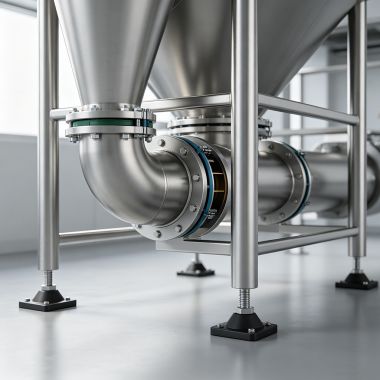


Description: Load‑bearing structural base for complete hydrocyclone desanding‑bank assemblies. General‑purpose foundation hardware for fixing hydrocyclone modules, feed distributors, overflow‑collection manifolds and underflow grit‑discharge piping. Guarantees installation perpendicularity and operational stability while reserving adequate service‑access clearance. Forms mechanical foundation for long‑term reliable desanding‑equipment performance.
1. Load‑bearing & installation‑accuracy control: Absorbs static equipment weight plus dynamic operating loads. Secures parallel‑bank hydrocyclones, feed distributors, instrumentation‑valves and collection‑piping assemblies at design elevation and spatial position. Rigid geometry maintains hydrocyclone verticality to prevent internal vortex‑field deflection caused by tilted units and safeguard desanding separation precision.
2. Vibration damping & operational stabilization: Mitigates equipment rocking triggered by feed‑pressure swings, slurry vortex‑impulse loading and pump‑derived vibration. Reduces vibration propagation toward piping and building‑steel‑work. Avoids secondary problems: seal‑joint leakage, accelerated spare‑part wear and erroneous instrument‑readings induced by mechanical resonance.
3. Integrated layout with reserved maintenance clearance: Multi‑tier frame architecture integrates feed‑zone, separation‑zone and grit‑discharge‑zone piping and components for tidy overall‑unit layout. Sufficient access clearance reserved for underflow‑nozzle, overflow‑pipe and hydrocyclone spare‑part exchange, shortening shutdown‑maintenance duration for continuous corn‑starch‑production‑line workflows.
4. Environment‑adapted corrosion‑protection: Material‑grade and surface‑treatment options selected for starch‑plant humid, mildly‑corrosive, frequent‑water‑wash operating atmosphere; inhibits long‑term rusting‑and‑deformation and extends overall‑equipment service‑life.
The support frames for corn starch desanding equipment are mainly divided into three categories based on the unit size and installation scenario:
1. Vertical multi‑tier frame (most‑widely‑adopted): Welded carbon‑steel / stainless‑steel multi‑level vertical frame. Upper tier anchors feed‑distributor and hydrocyclone top‑covers; intermediate tier constrains hydrocyclone‑main‑body location; lower tier accommodates underflow grit‑collection sump and discharge‑piping. High structural rigidity, compact footprint, suitable for standard‑capacity desanding‑banks with 4‑12 parallel hydrocyclone units.
2. Platform‑access support frame: Vertical‑frame base augmented with operator‑access platform plus safety hand‑railing. For large‑scale desanding‑banks or high‑elevation installation scenarios. Permits operators to safely perform top‑level instrument inspection, valve manipulation and overflow‑pipe maintenance complying with industrial‑safety‑operation‑codes.
3. Overhead hanging bracket assembly: For space‑constrained process sections. Suspends single‑unit / compact small‑scale desander from building‑steel‑beams or upper‑level platform undersides, conserving floor‑space and offering flexible piping‑interfacing. Mainly deployed for production‑line‑revamp‑projects or small‑capacity fine‑desanding duty stations.
Two mainstream material selections matching corn‑starch‑plant environmental characteristics:
1. Carbon‑steel anti‑corrosion support frame: Industry‑cost‑effective baseline solution. Fabricated from Q235 carbon‑steel weld‑ments; surface finished via paint‑coating, powder‑coating or epoxy anti‑corrosion lining. Delivers high load‑bearing capacity at favorable procurement‑cost, adequate for most process‑duty‑sets. Special attention must be paid to anti‑corrosion finishing at water‑retention‑prone zones: base anchor‑feet and weld seams.
2. Stainless‑steel support frame: Primarily 304 food‑grade stainless‑steel construction. Outstanding corrosion‑resistance, easy‑to‑wash surfaces with zero rust‑contamination risk; complies with food‑production‑hygiene‑specifications. Specified for high‑frequency‑cleaning, strict‑hygiene‑requirement refined‑starch‑processing sections, with higher procurement‑cost relative to carbon‑steel alternatives.

 Contact Us