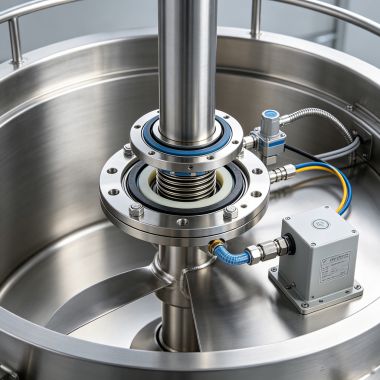


Description: Core wear prone spare for top entry steep tank agitators. Two primary variants: cartridge mechanical seal (industry mainstream for new builds) and packing gland seal (legacy older generation equipment). Prevents outward fugitive leakage of sulfurous acid steep liquor, steam and SO₂ corrosive gas along rotating agitator shafts.
Installed where agitator shaft penetrates steep‑tank top shell. Creates pressure‑tight demarcation between tank‑internal volume and plant‑site ambient environment. Stops steep‑liquor and protein‑rich process‑media leakage and suppresses corrosive sulfur‑dioxide‑gas escape. Seal failure leads to liquid spillage and gas emission, corroding gear‑reducer hardware and plant‑site infrastructure while contaminating workshop atmosphere. Large‑capacity corn steep‑tanks prioritize cartridge double‑end mechanical‑seal configurations.
① Cartridge Mechanical Seal (standard for new‑project builds)
1. Rotating ring & stationary ring (friction pair, SiC‑to‑SiC silicon‑carbide mating faces)
2. Spring assembly plus metal compression sleeve
3. Corrosion‑resistant O‑rings (PTFE‑encapsulated / FFKM perfluoro‑elastomer)
4. Seal housing and mounting‑flange base
5. Barrier‑fluid / flush‑fluid port (double‑end‑seal variant incorporates barrier‑fluid cavity)
Fully pre‑assembled modular cartridge unit; agitator full disassembly is unnecessary for spare‑part swap‑out, simplifying on‑site replacement workflows.
② Packing‑Gland Seal (legacy‑equipment only)
Stuffing‑box housing, PTFE‑graphite braided packing rings, gland follower, compression studs. Sealing action is achieved by compressing packing rings to grip agitator shaft; minor controlled weep‑leakage is inherent. This configuration is no longer specified for new corn‑starch‑steeping projects.
Mechanical seal: Spring pre load forces rotating ring / stationary ring faces into precise contact; a thin interfacing liquid film creates dynamic sealing barrier. Double end mechanical seal employs two friction pair interfaces; barrier fluid filling intermediate cavity completely blocks corrosive tank media egress, well matched for volatile sulfurous acid service. Packing gland seal: Compression squeezes soft packing material into conformal contact against rotating shaft surface for sealing; weeping leakage occurs during runtime, and agitator shaft wear is accelerated.
‑ Medium: Sulfurous‑acid steep liquor, corn‑protein suspended solids plus corrosive SO₂‑vapor
‑ Operating temperature: 48‑52 ℃; tank at atmospheric pressure
‑ Shaft rotational‑speed: 20‑60 r/min; long agitator‑shaft exhibits measurable radial deflection
1. Seal metallic wetted hardware: 316L stainless‑steel; springs must resist sulfurous‑acid corrosion
2. Friction‑pair faces: Silicon‑carbide against silicon‑carbide (SiC‑SiC); resistant to particulate abrasion and weak‑acid corrosion
3. Elastic sealing elements: PTFE‑jacketed O‑rings / FFKM perfluoro‑rubber. Ordinary FKM fluoro‑rubber will swell and fail under prolonged sulfurous‑acid exposure.
4. Preferred construction: Cartridge‑style double‑end mechanical seal with barrier‑fluid connection port
5. Recommended barrier / flush medium: De‑mineralized water or food‑grade barrier‑fluid.
1. Complete pre‑assembled cartridge unit simplifies installation‑and‑alignment and lowers risk of on‑site assembly‑related defects.
2. SiC‑SiC friction‑pair withstands fine‑protein‑particle abrasion; resists sealing‑face damage induced by minor solid‑particle entrainment.
3. Double‑end sealing geometry blocks sulfurous‑acid‑liquid and SO₂‑gas leakage, mitigating corrosive plant‑site‑atmosphere degradation.
4. All wetted components exhibit sulfurous‑acid corrosion resistance for food‑grade starch‑steeping‑process conditions.
5. Barrier‑fluid‑monitoring connection port permits early‑stage internal‑seal‑damage diagnostics to avoid sudden large‑volume process‑media leakage events.

 Contact Us