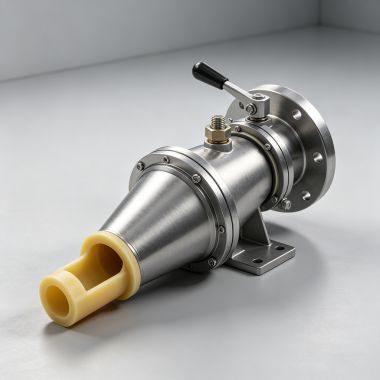


Description: Bottom discharge wear‑part for desanding hydrocyclones, also termed sand‑discharge nozzle or underflow outlet. Installed at hydrocyclone / desander bottom, it steadily expels separated sand grit, heavy‑density impurities and high‑solids underflow slurry. Despite compact geometry, it exerts direct control over desanding efficiency, underflow concentration and starch‑loss ratio.
1. Discharge sand and heavy impurities: Inside hydrocyclones, centrifugal force drives sand, fine grit and high‑density contaminants along conical inner walls for final ejection through this nozzle.
2. Regulate underflow concentration: Nozzle outlet dimension governs underflow solids content. Excessively large bore causes excessive starch‑slurry carry‑over losses; undersized bore results in poor sand evacuation and grit accumulation.
3. Stabilize internal hydrocyclone flow‑field: Proper underflow discharge sustains balanced outer / inner vortex patterns and reduces pressure swings plus abnormal separation performance.
4. Protect main‑unit hardware as consumable wear‑part: Concentrated grit‑laden flow generates severe erosion at this component. Designed as a standalone replaceable spare; only the nozzle needs swapping instead of scrapping the complete desander assembly upon wear.
1. Fixed‑orifice underflow nozzle: Simple construction with non‑adjustable outlet opening; stable performance for production lines with consistent operating parameters.
2. Adjustable‑orifice underflow nozzle: Variable outlet aperture configurable according to real‑world sand‑discharge conditions; suited for processes with fluctuating feed loading, incoming sand content or target underflow concentration.
Available material grades: high‑wear cast iron, stainless steel, ceramic composite, polyurethane.
‑ High‑wear cast‑iron: cost‑effective for general‑duty applications
‑ Stainless steel: superior corrosion resistance for starch‑processing hygiene‑critical service
‑ Ceramic / composite: outstanding erosion resistance for high‑grit heavily‑abrasive conditions.
Corn‑starch‑line material selection shall comprehensively evaluate incoming sand content, wear rate, cleaning requirements and project budget.
Within corn‑starch desanding hydrocyclones, incoming starch slurry generates high‑speed vortex flow. Dense sand grit is thrown against cone walls and migrates downwards to converge at the bottom discharge zone. The underflow nozzle expels grit‑rich high‑concentration underflow; desanded starch slurry forms upward‑traveling central inner vortex and flows out through overflow systems toward downstream refining steps.
Healthy nozzle operation delivers steady sand ejection and stable underflow concentration. Blockage impedes sand evacuation and degrades desanding effectiveness. Severe nozzle wear enlarges outlet bore, diluting underflow and triggering starch‑slurry loss mixed with discharged grit.

 Contact Us