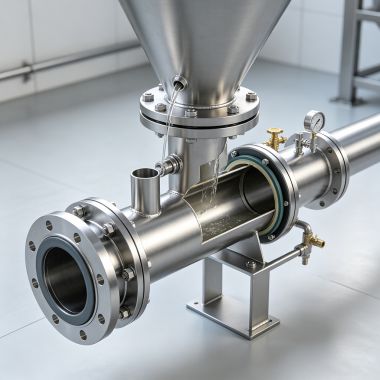


Description: Also named overflow outlet or central discharge pipe. Core top‑section wetted component for desanding hydrocyclones. Its lower end inserts into hydrocyclone inner cavity; upper end connects to overflow header piping as discharge channel for purified starch slurry. Its inner bore, insertion depth and inner‑wall abrasion resistance directly govern hydrocyclone separation precision and throughput, critical component securing starch‑slurry cleanliness for desanding section.
- Discharge purified starch slurry
- Modulate internal hydrocyclone vortex flow‑field
- Modular wear‑resistant construction
- Stabilize throughput per single hydrocyclone unit
Monotubular construction. Upper‑end flange or threaded connection fastens assembly to hydrocyclone top cover and links to overflow collection manifold. Lower‑end insertion section extends down into hydrocyclone cylindrical cavity. Inlet edge adopts smooth transition profile to minimize vortex‑field disturbance. Heavy‑duty version features reinforced thick‑walled inlet for heavy slurry impingement.
For corn‑starch desanding service, monoblock cast polyurethane is the preferred material, matching hydrocyclone body and underflow‑nozzle material for good wear‑resistance and anti‑fracture performance for grit‑laden starch slurry. 304 / 316L food‑grade stainless steel is adopted for low‑abrasion high‑sanitation‑priority scenarios. Ceramic‑lined overflow pipes are selected for extreme heavy‑erosion service to extend lifespan. Compared with underflow nozzles, overflow pipes exhibit slower wear rate and longer replacement cycle; PU overflow pipes achieve service life of 6000‑8000 hours under nominal operating conditions.
Pressurized starch slurry enters hydrocyclone tangentially and forms high‑velocity outer vortex. Grit particles are centrifugally forced onto chamber wall and slide along conical contour down to underflow nozzle for discharge. Lower‑density starch slurry converges toward central axis and forms upward inner vortex, enters overflow‑pipe lower inlet, flows upward out of hydrocyclone and merges into overflow manifold for downstream refining.
Overflow‑pipe insertion depth is key process parameter: Over‑deep insertion compresses separation zone and causes incomplete fine‑grit removal; insufficient insertion depth triggers feed‑fluid short‑circuit directly entering overflow outlet and impairs desanding efficiency. Standard industrial design sets insertion depth around mid‑lower section of hydrocyclone cylindrical body; dimension must coordinate with hydrocyclone cone angle and underflow‑nozzle bore size.

 Contact Us