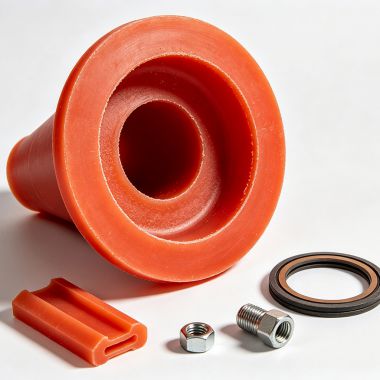


Description: Core high‑wear spare part fitted at bottom of desanding hydrocyclones, acting as centralized discharge outlet for sand, grit and heavy impurities. It suffers the most severe abrasive erosion within hydrocyclone assembly and requires frequent change‑out. Its bore dimension and wear condition directly determine overall desanding efficiency and starch loss rate, key maintenance focus for corn‑starch desanding section.
Functions
1. Regulate sand-discharge rate and separation accuracy: Underflow-nozzle bore is critical hydrocyclone parameter.
Proper-sized nozzle continuously discharges high-density grit via underflow while purified low-density starch slurry flows out through top overflow.
Excessively large bore leads to valuable starch slurry escaping with grit (“product loss”). Too-small bore hinders grit evacuation.
Fine sand carries over to downstream process and abrades disc separators, pumps and other equipment. Withstand peak abrasive erosion: Centrifugally separated grit all pass through this component at high velocity and high solid concentration.
Making it the most erosion-prone part across the hydrocyclone. Hence it is manufactured from high-wear monolithic materials.
Modular wear-part design: Standardized independently replaceable component. Only nozzle needs disassembly & replacement upon wear instead of full hydrocyclone assembly replacement.
Greatly cutting maintenance expense and production downtime.
Operating Process Corn starch slurry enters hydrocyclone tangentially at 25–0.40MPa and creates high-speed vortex field.
High-density grit and heavy contaminants are thrown onto cone wall by centrifugal force spiral downward along conical inner contour and converge at underflow nozzle for discharge.
Purified starch slurry forms central upward inner vortex and exits through top overflow port for next refining process.
Commonly Used Materials and Selection The underflow nozzles commonly used in the corn starch industry are mainly divided into three types of materials.
Which can be flexibly selected according to the sand content of the raw materials and the wear intensity of the working conditions:.
Polyurethane underflow nozzle: Industry mainstream with excellent cost-performance. Balanced wear resistance and toughness, good fine-grit erosion resistance and fracture resistance.
For starch slurry with normal sand content; service life 4000–6000 hours, best-matched with PU hydrocyclone bodies.
Alumina-ceramic underflow nozzle: Higher hardness & better wear resistance than polyurethane for heavy-grit high-erosion process conditions.
Limitation: brittleness; reduce heavy impact during installation and removal. Cemented-carbide underflow nozzle: Top-tier wear resistance and longest service life, yet highest procurement cost.
Only deployed for extreme high-grit heavily-abrasive working scenarios.

 Contact Us