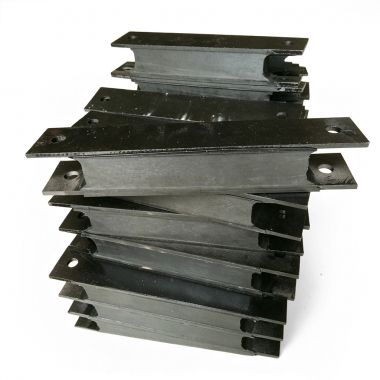


Description: Rubber springs are the core vibration isolation and damping elastic elements of vibrating screens and fiber screening equipment. They are installed between the screen box base and the frame, and rely on the elastic deformation and damping effect of the rubber to support the screen body, buffer the excitation force and isolate the transmission of vibration to the ground.
Rubber is a polymeric material with high elasticity. When the vibration motor drives the screen body to vibrate at high frequency, the rubber spring is repeatedly compressed and rebounds. The internal friction damping of the rubber consumes vibration energy, reducing equipment noise, allowing the screen to pass smoothly through the resonance range and blocking the transmission of vibration to the base and the building, thus preventing foundation resonance. At the same time, it constrains the motion trajectory of the screen body, preventing the screen from drifting, swaying and losing balance.
1. Load bearing and support: Bears the overall weight of the screen frame, screen mesh and material;
2. Elastic vibration transmission: Ensures that the screen box can vibrate stably at high frequency to achieve screening of fiber materials;
3. Vibration isolation and noise reduction: Isolates vibration from being transmitted to the ground, significantly reducing the operating noise of the whole machine;
4. Buffer protection: Absorbs the impact of falling material, reducing fatigue damage to the screen box and the vibration motor;
5. Multi-directional limiting: It can withstand axial, transverse and shear forces in multiple directions, stabilizing the motion trajectory of the screen body.
1. Pure rubber spring (the cylindrical type is the most commonly used, and is the first choice for fiber rotary vibrating screens)
Solid or center-bored rubber column without built-in metal parts; mostly used in small and medium-sized rotary vibrating screens, fiber screening machines and light linear screens.
2. Composite rubber spring (metal-rubber integrated)
Built-in steel helical spring with an outer vulcanized rubber coating; it has a greater load-bearing capacity and a longer service life, making it suitable for high-capacity heavy-duty screening equipment.
3. Shear-type rubber spring (laminated steel plate and rubber)
It has excellent transverse shearing properties and is often used in flip-flow screens and high-frequency fiber dewatering screens.
1. Natural rubber (NR): Good elasticity and high damping, suitable for dry fiber screening at room temperature;
2. Ethylene propylene diene monomer (EPDM) rubber: Water-resistant and aging-resistant, suitable for wet slurry and humid conditions;
3. Oil-resistant synthetic rubber: Selected for oily environments;
Ordinary rubber is suitable for temperatures from -30 °C to +70 °C. High temperatures will accelerate aging and cracking.

 Contact Us