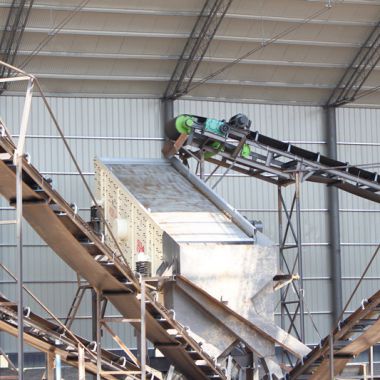


Description: The undersize hopper (also called undersize chute or undersize receiving hopper) is a non-standard material guiding component installed directly below screening equipment such as vibrating screens and drum screens. It is specially designed to receive the fine material (undersize) falling through the screen mesh and to collect and guide it to a belt conveyor, chute or downstream equipment. It is an essential supporting component of the screening system.
1. Material collection and guidance: It collects all qualified fine material passing through the screen panel, gathers the scattered falling material to the lower discharge outlet and conveys it to the next process equipment.
2. Sealed and dustproof: It encloses the discharge space at the bottom of the screen, reducing dust, splashing and spillage, thus improving the workshop environment.
3. Buffer protection: It reduces the impact of falling material and protects downstream belt conveyors and equipment; wear-resistant liners are installed on the inner wall of the hopper to reduce wear of the hopper body caused by the material.
4. Diversion/anti-clogging: It can be made into a multi-outlet structure according to the process; some designs include an anti-clogging structure to prevent wet and sticky material from agglomerating and blocking the hopper.
• Top opening (feed inlet): Large opening, sized to match the discharge range of the vibrating screen and located directly below the screen panel; a vibration gap is reserved between the screen body and the top opening of the hopper to prevent collision during screen operation.
• Hopper body (conical section): Gradually narrows from top to bottom, commonly square/rectangular conical or circular conical; wear-resistant steel plates or cast stone plates can be welded to severely worn areas.
• Lower outlet (discharge port): A smaller flange opening for connecting to downstream equipment such as chutes, belt conveyor guide troughs and screw conveyors.
• Optional accessories: Dustproof sealing rubber sheet, inspection door, observation port, anti-blocking vibrator, wear-resistant lining and spillage curb structure.
1. Ordinary carbon steel Q235: For dry, lightly abrasive materials;
2. Wear-resistant steel plate/cast stone lining: For highly abrasive materials such as ore and coal;
3. Stainless steel 304/316: For food, starch and chemical materials, and where corrosion resistance is required.

 Contact Us