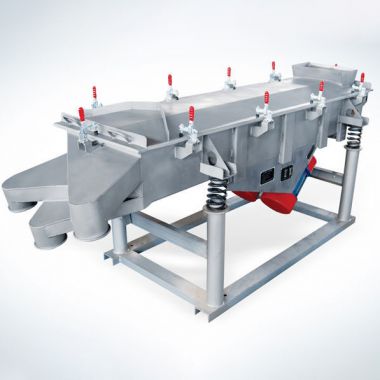


Description: The oversize collection trough, also called coarse material collection trough, oversize collection hopper or oversize discharge trough, is a material collection and guiding component fitted to the tail end of a vibrating screen. It receives the coarse fibers, long fibers, agglomerated materials and impurities that cannot pass through the screen mesh and remain on the screen surface, and collects and smoothly discharges the oversize material out of the screening equipment, sending it to the next process, for reprocessing, or to the waste bin.
Material enters the screen surface; fine fibers pass through the screen mesh and become the undersize material; long fibers, agglomerated fibers and impurities are retained by the screen mesh and move along the screen surface to the discharge end under the vibration of the screen body, falling into the oversize collection trough, where they are guided by the inclined surface of the trough and discharged from the equipment through the discharge outlet.
1. Material receiving: It receives the long fibers, coarse materials and screen residues discharged from the screen surface to prevent the material from scattering.
2. Flow guiding and conveying: The inclined trough wall guides the oversize material to flow out in a directional manner, and can be connected to pipelines, conveyors and return pipelines.
3. Buffering and deceleration: It reduces the impact of falling fibers, minimizing fiber splashing and dust.
4. Sealed and dustproof: The fully enclosed collection trough reduces the escape of fiber dust and improves the workshop environment.
5. Diversion and isolation: Each deck of the multi-deck screening machine is equipped with an independent collection trough, so that the oversize and undersize materials do not mix.
1. Trough body: U-shaped/bucket-shaped shell with an inclined guide slope;
2. Feed flange: Connects to the oversize discharge outlet at the tail of the screen box;
3. Discharge outlet: Connects to an external hose, screw conveyor or return pipeline;
4. Inspection and cleaning port (optional): Facilitates the cleaning of tangled and agglomerated fibers;
5. Sealing gasket: Seals the flange connection to prevent fiber dust from leaking out.

 Contact Us