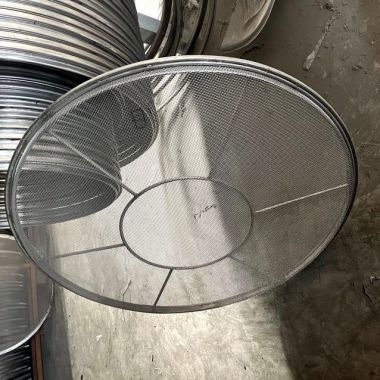


Description: The screen frame is the core load-bearing component of fiber screening machines (rotary vibrating screen, linear screen, air classifier, paper pressure screen, etc.). It is used to tension and fix the screen mesh, providing a stable screening surface for fiber materials. Working together with the screen cleaning device, it solves the screening problems of fibers that easily tangle, agglomerate and blind the mesh.
1. Tensioning and fixing the screen mesh: The screen mesh is tensioned evenly to ensure a flat screen surface and to prevent fibers from snagging and the mesh from slackening and sagging.
2. Load bearing and vibration transmission: It receives the fiber material and transmits the excitation force of the equipment, so that the fiber bundles are fully dispersed and classified.
3. Sealing and leak prevention: Working with rubber sealing strips, it prevents short fibers and fine powder from leaking through the gaps between screen decks and mixing with other fractions.
4. Accommodating cleaning accessories: The internal space can accommodate bouncing balls, ultrasonic screen frames and support meshes, reducing the probability of fiber blinding.
5. Deck separation: Multiple screen frames are stacked to achieve multi-stage classification of long, medium and short fibers.
A complete screen frame generally consists of five parts: the outer frame body, the screen pressing strip, the sealing strip, the support mesh and the locking fasteners.
• Outer frame body: The main skeleton of the screen frame, which can be round (rotary vibrating screen), rectangular (linear screen) or cylindrical (paper pressure screen drum);
• Screen pressing component: Presses the edge of the screen mesh to ensure uniform tension across the screen surface;
• Support bracket (mother-and-child screen structure): The lower support mesh protects the fine screen mesh and reduces fiber impact;
• Sealing strips: Seal the gaps between the frames to prevent material leakage;
• Locking clips/bolts: Allow quick assembly and disassembly, facilitating the removal of fibers tangled on the screen mesh.
1. 304/316L stainless steel (most commonly used): Corrosion resistant, high strength, vibration resistant and non-shedding; suitable for paper pulp fibers, plant fibers, chemical fibers, and food and pharmaceutical fiber slurries, for both dry and wet screening. Duplex stainless steel can be selected for corrosive slurries.
2. Solid wood (pine, poplar): Low cost and light weight, mostly used for dry fiber powder; its disadvantages are that it is not water resistant and prone to mold, and it cannot be used for screening wet fiber slurry.
3. Polyurethane/engineering plastics: Wear-resistant and low noise; used for lightweight fibers and to prevent metal debris from contaminating the material.

 Contact Us