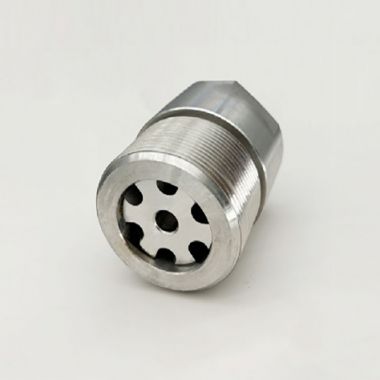


Description: A spray nozzle is a core component at the end of a spray piping system. It converts the pressurized liquid in the pipeline into spray droplets with a set shape, angle and droplet size, completing gas-liquid contact processes such as washing, cooling, absorption, dust removal, humidification and cleaning. It is widely used together with spray headers and branch spray pipes.
Pressurized liquid enters the nozzle cavity and changes its flow direction through the flow channel, vortex cavity or spiral structure. Pressure energy is converted into kinetic energy, and the liquid is torn and broken up to form droplets. Multiple nozzles on the same spray pipe are arranged in a staggered pattern so that the spray areas overlap, achieving 100% to 250% full coverage spraying inside the tank or tower.
1. Flat-Fan Nozzle: It sprays a flat, ribbon-like liquid curtain; the spray angle is 30° to 180°; suitable for surface cleaning, pipe wall rinsing and cooling.
2. Full-Cone Nozzle: The spray covers the entire circular area with uniform flow distribution; suitable for washing, humidification and dust suppression in spray towers.
3. Hollow-Cone Nozzle: The liquid is concentrated in the outer ring, with no liquid in the center; the droplets are finer and the gas-liquid contact area is larger; it is the first choice for desulfurization and exhaust gas spraying.
4. Spiral Nozzle: It has no internal vortex core and features a large flow passage, providing strong anti-clogging performance; suitable for spraying slurries containing a small amount of solid impurities; both full-cone and hollow-cone patterns are available.
Stainless steel 304 / 316L: For food, starch, citric acid and sorbitol production lines, clean water and weakly corrosive media; the most commonly used material for export projects.
Silicon carbide (SiC): For highly corrosive and abrasive slurries, such as desulfurization towers in power plants; wear-resistant and corrosion-resistant.
Engineering plastics PP / PVDF / PTFE: For strong acid and strong alkali service at low temperatures.
Brass: For clean water and general cooling duties; low cost; rarely used in the food industry.

 Contact Us