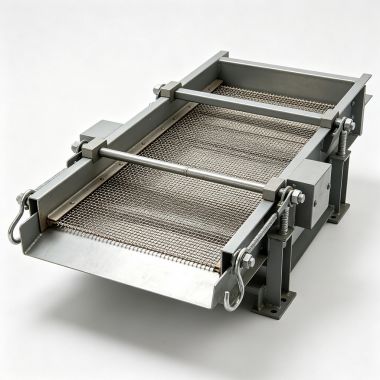


Description: The screen tensioning device is a supporting fastening assembly for grain linear vibrating screens and corn primary cleaning screens. It consists of pressure bars, tension hooks, adjusting bolts, pressure plates, locking washers and other parts, and is assembled on both sides of the screen frame. Its function is to evenly tighten and fix the stainless steel or polyurethane screen mesh, keeping the mesh flat and taut, preventing the mesh from loosening, bulging in the middle or material deviation during screening operations, avoiding premature damage caused by repeated impacts between the mesh and the screen frame, and ensuring stable corn impurity removal and grading results.
By rotating the adjusting bolts, the hooked-edge screen mesh is pulled to continuously apply lateral tension and stretch the mesh evenly. The upper and lower pressure bars then press the edges of the mesh together to lock them in place, ensuring consistent tension across the whole mesh. During vibrating operation, large-amplitude shaking of the mesh is restricted, reducing the generation of broken corn while maintaining the standard screening amplitude and lowering the probability of clogging.
1. Hooked-edge bolt tensioning type (most commonly used in grain machinery): The screen mesh is processed with hooked edges and is combined with tension hooks and adjusting screws. It offers a large adjustment stroke, adjustable tensioning force and convenient assembly and disassembly, and is suitable for the stainless steel woven screen mesh of corn cleaning screens.
2. Pressure bar and plate clamping type: Multiple steel pressure bars are used together with bolts to press the edge of the screen mesh, providing uniform stress distribution. It is mainly used for perforated screen plates and wide polyurethane screen meshes.
3. Wedge clamping type: Fixation is achieved by squeezing wedge blocks, without the need for a large number of screws. It allows quick assembly and disassembly and is suitable for equipment at corn purchasing stations where the screen mesh needs to be replaced frequently.
1. The tension is adjustable, so the entire screen mesh can be tightened evenly and local slack is eliminated;
2. The locking is firm and not easy to loosen or slip off under long-term high-frequency vibration;
3. The structure is simple, making it convenient for on-site workers to quickly assemble, disassemble and replace screen meshes with different apertures;
4. It reduces fatigue wear of the screen mesh, effectively extends the service life of the mesh and reduces production line downtime;
5. It is compatible with various frame structures such as wooden screen frames and carbon steel / stainless steel screen frames.

 Contact Us