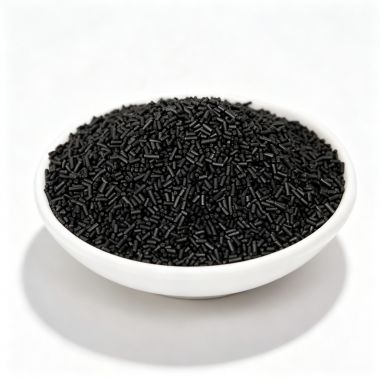


Description: Carbon molecular sieves are the core adsorption medium of PSA nitrogen generators. They are filled inside two adsorption towers and, together with palm pads, perforated plates, and wire mesh, form an adsorption bed. They rely on kinetic sieving to separate oxygen and nitrogen from the air, directly determining the nitrogen purity, gas production, and air consumption ratio.
1. Oxygen-nitrogen kinetic separation: Under pressure, oxygen molecules in the air are preferentially adsorbed, while nitrogen is not adsorbed and flows out directly to obtain the finished nitrogen product; when the pressure in the tower is reduced, the adsorbed oxygen is desorbed and discharged, the molecular sieve is regenerated, and the alternating cycle of the two towers achieves continuous nitrogen production.
2. Ensuring nitrogen production targets: The performance of molecular sieves directly determines nitrogen purity (95%-99.999%), gas production, and air consumption ratio.
3. Bed layer arrangement: The upper and lower palm pads are pressed together to reduce particle jumping and pulverization, and maintain bed stability.
Appearance: Black cylindrical or strip-shaped granules; industrially commonly used particle size is 1.0-1.8 mm; common grades are CMS-220, CMS-240, and CMS-260, with the numbers representing nitrogen yield grades.
Raw materials: coconut shell charcoal, anthracite, and polymer resin; after crushing, mixing, extrusion molding, high-temperature carbonization, activation, and fine adjustment of pore size by vapor deposition, qualified carbon molecular sieve particles are obtained.

 Contact Us