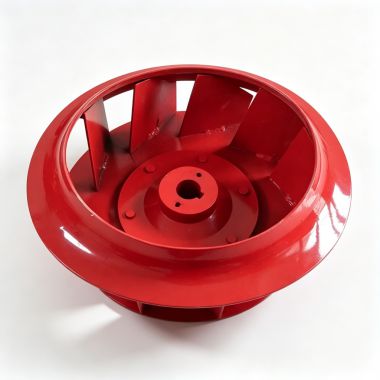


Description: The impeller is the only rotating core component of a centrifugal fan that performs work on the gas, directly determining the fan's flow rate, total pressure, and efficiency.
1. Energy conversion: The motor torque drives the impeller to rotate at high speed, and the blades push the gas. Using centrifugal force, the impeller converts mechanical energy into the gas's kinetic and static-pressure energy, thereby delivering the pressurized gas.
2. Gas flow guidance: Converts the axially incoming gas into radially ejected gas and sends it into the volute.
3. Operating-condition compatibility: Based on the blade type, structure and material, it is adaptable to different media such as clean air, dust-laden gas, high-temperature gas, and corrosive exhaust gas.
4. Rotor balance requirement: The form and position (geometric) accuracy and dynamic balance quality of the impeller directly determine the vibration of the whole machine and protect the bearing housing and main shaft from impact damage.
are classified into closed impellers, semi-open impellers, and open impellers. Closed impellers are the most commonly used.
Components of a closed impeller:
1. Hub: The central component with a keyway, which mates with the main shaft to transmit torque and connect to the rear plate.
2. Rear plate (back plate): A disc that is welded/riveted to fix the blade root, connects to the hub, and bears the rotational centrifugal stress.
3. Blades: Key components that perform work on the gas; available in flat, arc, and airfoil shapes; classified into three main categories: backward, radial, and forward.
4. Front shroud (inlet shroud): Conical/arc-shaped cover plate on the intake side, which closes the blade flow channel, reduces gas backflow and leakage, and improves efficiency.
Ordinary carbon steel Q235-B, wear-resistant steel NM360/NM400, stainless steel 304/316L, heat-resistant steel 12Cr1MoV, aluminum alloy, fiberglass FRP

 Contact Us