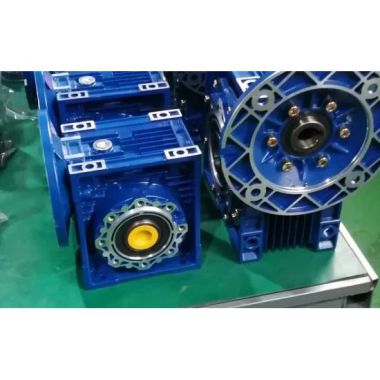


Description: The speed reducer is the core component of the belt-conveyor drive unit. It converts the motor's high speed and low torque into the low speed and high torque required by the belt pulley, driving the conveyor belt to transport bulk corn. There are two main types: the helical-gear reducer (hardened tooth surface) and the worm-gear reducer; both are used in corn-starch plants and grain-depot projects.
Hardened-Gear Reducer (helical gear, heavy-duty unit) Alloy-steel helical gears, multi-stage meshing; cast-iron housing, hardened and ground gears.
Input and output shafts arranged in parallel; grain conveyors commonly use ZLY/ZSY/R/F/K series hardened-tooth-surface reducers.
High-capacity main belt conveyors, long-distance, horizontal corn conveying, 24-hour continuous operation; main receiving and storage lines with belt widths 650–1200mm and capacities 80–500 t/h.
High transmission efficiency of 94%–97%, power-saving in continuous operation, suited to long uninterrupted production.
Impact- and heavy-load resistant, long service life (design life ≥ 30,000 hours), highly reliable in dusty environments.
Wide power range: 2–200 kW, the first choice for high-flow corn conveying. Good heat dissipation and low temperature rise, suited to continuous starch-plant production.
Common grain-industry ratios: 16–50; protection rating IP55; splash lubrication with industrial gear oil.worm gear reducer Worm (hardened alloy steel) + worm wheel (tin bronze).
With perpendicular shafts at 90°; housing of aluminum alloy or cast iron; commonly NMRV and WP series for grain conveying.
Small- and medium-sized belt conveyors, inclined feeding conveyors, auxiliary feeding conveyors, and small loading conveyors.
Power generally ≤ 15 kW. Built-in reverse self-locking holds the pulley stationary at standstill stop material back-slide on inclined conveyors.
And may remove the need for a separate brake. Compact, small, flexible installation—flange or foot-mounted. Low noise, economical.
Common grain-industry ratios: 20–80; suited to intermittent, low-to-medium capacity, inclined corn conveying.

 Contact Us