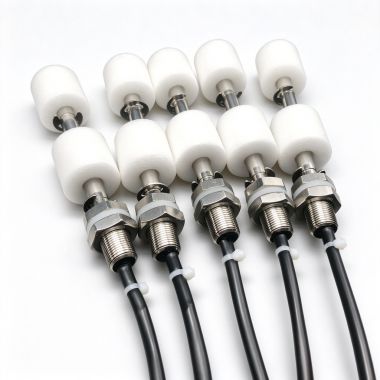


Description: Water tank level monitoring sensor generating on off electrical signals for automatic water refill and low level interlock protection.
Installed within washing machine water tanks, it monitors liquid height and transmits switch signals to the electrical control system for auto water refill and low liquid level protection. Under low water conditions it interlocks heating elements and circulating pumps to prevent dry firing and pump dry run damage, securing safe water system operation.
Float body: Food grade PP, PVDF or 304 / 316L stainless steel. PP offers cost effective performance; PVDF provides strong acid alkali resistance. Cable: Food grade waterproof corrosion resistant cable.
1. Miniature Cable Suspended Float Switch: Hanging mounted, simple installation; most common option for food processing water tanks.
2. Rod Mounted Float Switch: Fixed rod installation for compact layout tanks. Functional variants: Single float single level type; dual float high low level combined switch assemblies.
1. Float Seizure: Food residues or fibrous debris jam / tangle around float or connecting rod, inhibiting buoyancy driven travel and producing level signal failure.
2. Float Water Ingress & Internal Failure: Long term hot water and chemical agent exposure degrades weld seams, allowing water ingress and sinking of the float body.
3. Cable Degradation & Rupture: High humidity high temperature environment plus detergent corrosion crack cable sheaths, creating short circuit or signal loss faults.
4. Scale Encapsulation: Mineral scale and protein deposits build up on float outer surfaces increasing effective weight and triggering operational malfunction.
1. Per Shift Inspection: Verify float responsive travel during water level variation; check for binding conditions.
2. Periodic Cleaning: Remove float assemblies to clean tangled debris and mineral scale from float and connecting rods.
3. Cable Condition Check: Inspect outer sheath for cracking or aging; secure cabling to avoid tensile pulling stress.
4. Operating Requirements: Prevent hard object impact damage to floats; minimize debris tangling risk.
5. Replacement Criteria: Replace unit immediately for water logged sunken floats, shell cracking, signal loss or severe cable aging.
Float switches implement critical tank level safety protection enabling auto refill and low level interlock to avoid heater dry out and pump dry running. Regular removal of tangled debris and scale together with float and cable integrity checks guarantee reliable level protection performance.

 Contact Us