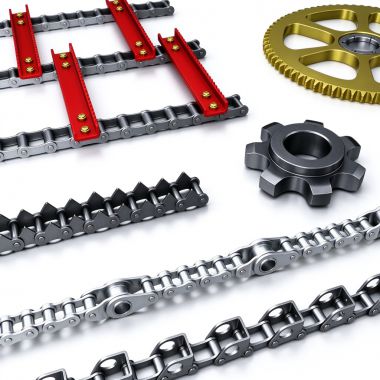


Description: Critical power transmission wearing part for food grade continuous spray washers; transfers motor torque to conveyor mesh belts under humid high duty wash environment conditions.
As core power transmission component of food grade continuous spray washing machines, it cooperates with conveyor mesh belts and drive sprockets. It smoothly transmits geared motor torque to mesh belts, transporting turnover baskets, food trays and other workpieces sequentially through pre wash, main wash, rinse and air blow stations for fully automatic continuous conveying. Operating continuously in humid, high temperature environments with scale and food residues, the chain requires high corrosion resistance and stable running performance as a key wearing component for uninterrupted production.
1. 304 Stainless Steel Chain: Standard equipment configuration; water resistant, tolerant to common acid alkali detergents, low rust tendency, suitable for water temperatures up to 80 °C. Good toughness and mechanical strength complying with food hygiene requirements for most food washing machines.
2. 316L Stainless Steel Chain: Premium anti corrosion option with superior chloride ion and chemical media resistance. For harsh service with salt containing or strong acid alkali detergents; improved high temperature and corrosion resistance for extended service life.
3. Engineering Plastic Chain: Light weight corrosion resistant alternative, rust free and low noise operation. For low temperature light duty rinse stations with lower load bearing capacity than metallic chains.
1. Standard Roller Drive Chain: High versatility and transmission accuracy; installed at main drive ends to deliver full mesh belt power transmission. High load capacity and stable running as primary drive chain.
2. Side Bending Conveyor Specific Chain: Enhanced flexibility for corner sections and tension adjust zones, compatible with closed loop conveyor layouts of spray washing equipment.
By assembly construction: Integral type chains and segmented chains. Segmented chains support local worn section replacement without complete disassembly for simplified maintenance, widely preferred for food machinery.
1. Chain Corrosion, Seizure & Abnormal Noise: Persistent humid high temperature wash conditions plus acid alkali detergents leave residual moisture and food debris in pin bushing clearances, triggering metallic corrosion, link seizure, vibration and abnormal noise.
2. Chain Elongation, Slackness and Slippage: Long term cyclic loading together with thermal cycling causes link wear and pitch enlargement. Overall chain elongation reduces tension leading to slippage, inconsistent conveying speed and workpiece offset or stalling.
3. Link Wear, Deformation & Fracture: Workpiece overloading / offset loading or mesh belt jamming / mis tracking creates uneven chain stress, causing plate deformation and pin loosening. Severe cases produce link fracture and equipment shutdown.
4. Debris Induced Seizure: Food residues, grease and scale compact within link gaps upon drying, inhibiting free link articulation, accelerating local wear and potentially triggering seizure and power overload.
5. Corrosion Aging Failure: Ordinary chain materials exposed to aggressive cleaning media develop pitting and material thinning, lowering mechanical strength and increasing fracture risk.
1. Pre Shift Inspection: Before startup inspect chain running condition, listen for abnormal noise or vibration, verify uniform tension and absence of binding or offset; remove surface food residues and grease promptly.
2. Periodic Descaling & Cleaning: After daily shutdown clean chains with warm water and food grade detergent to flush gap trapped residues and scale; soak with food grade citric acid for heavy fouling to preserve free link rotation and avoid seizure.
3. Tension Adjustment (Weekly): Inspect chain slack regularly and adjust tensioners for elongated chains to maintain correct sprocket chain meshing and prevent slippage, offset and accelerated wear.
4. Anti Corrosion Care: Industrial grade lubricants are strictly forbidden for food processing equipment (risk of oil contamination and bacterial growth). Apply food grade lubricant spray to reduce friction and retard rust. Thoroughly dry chains post cleaning to eliminate residual moisture.
5. Wear Inspection & Replacement (Monthly): Inspect pins, sleeves and link plates for wear and deformation. Replace worn segments when excessive elongation, heavy corrosion, deformation or binding occurs to prevent unexpected in service fracture and shutdown.
6. Operational Discipline: Forbid equipment overloading and forced workpiece dragging to avoid shock load chain damage. Thoroughly clean and dry chains for corrosion protection before long term idle storage.
Drive chains constitute the power transmission heart of spray washing machines and directly govern conveying stability and continuous production capability. Good corrosion resistance, wear resistance and flexible articulation ensure steady workpiece transit through washing stations and consistent cleaning performance. Systematic routine cleaning, tension tuning and anti corrosion maintenance extend service life, cut unplanned downtime and satisfy continuous hygienic production requirements for food manufacturers.

 Contact Us