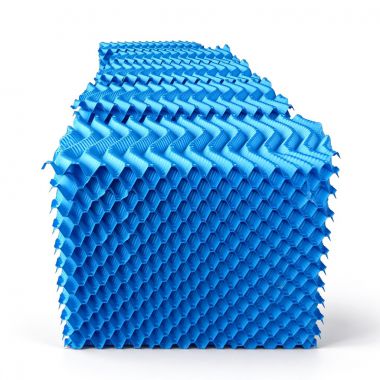


Description: Core heat transfer media for cooling towers, where hot water film contacts counter current air for evaporative cooling.
Hot water spreads over fill surfaces forming thin water films and contacts counter flow air. Heat is removed via combined evaporative and convective heat transfer to cool process water. Fill performance directly defines overall cooling tower capacity.
Baffle type assembly of corrugated / curved sheets spaced to form air flow channels. Major patterns:
1. Zig Zag (V Shape / M Shape): Multiple sharp angular bends; high droplet capture efficiency with relatively higher air side resistance.
2. Curved Arc Profile: Smooth radiused flow turns, low air resistance, slightly inferior water capture versus zig zag geometry.
3. Reinforced Bi Directional Corrugation: Balanced droplet capture and pressure drop; widely used on large cooling towers.
4. S Wave Oblique Cross Corrugated Fill (PVC sheets): Dominant industrial cooling tower grade; continuous S form corrugations with interleaved flow channels to enhance air water turbulence for high heat transfer efficiency and low weight. Available as bonded blocks or hot press monolithic modules.
5. Dot Wave Fill: Surface covered with raised dimples to break up water streams and prevent wall runoff; common for cross flow towers and combinable with S wave packs.
6. T Wave / Bi Directional Wave: Dual orientation corrugations for improved water distribution and moderate anti scaling properties; widely used for large utility cooling towers.
7. Grid Splash Fill (Concrete / Plastic Grids): Legacy large opening grid construction; excellent anti clogging performance at the cost of lower heat transfer efficiency; for heavily contaminated recirculating sewage water.
8. Baffle Style Anti Clog Fill: Oversized flow passages for sewage application cooling towers.
1. PVC (Polyvinyl Chloride): Most popular for ambient temperature cooling towers; low cost and good formability. Risk of softening and collapse under sustained water temperature >55 °C.
2. PP (Polypropylene): Service temperature up to 70 80 °C, superior acid alkali resistance compared with PVC; lower structural rigidity and higher material cost, for chemical process and elevated temperature water applications.

 Contact Us