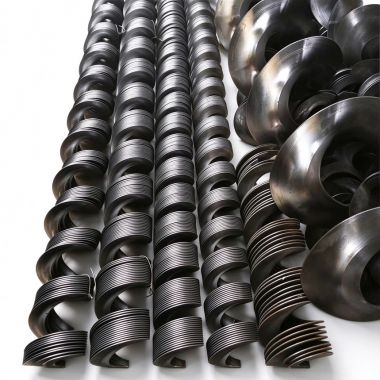
Description: Core working components of screw conveyors (augers). Mounted onto the central shaft, they rotate to push materials axially for continuous conveying and mixing.
Spiral blades are welded or assembled onto the central drive shaft. As the shaft rotates, the helical surfaces push materials axially along the trough housing to achieve continuous conveying. They can also perform auxiliary material mixing, agitation and feeding.
1. Solid Pitch Blades (Full Flight, Most Common): Continuous full helical surface; pitch normally equals blade diameter. Ideal for powders and fine granular materials (starch, powdered sugar). High conveying efficiency; preferred for free flow bulk solids.
2. Ribbon Type Blades (Notched Flight): Non continuous flight with peripheral notches in ribbon shape. Suited for highly viscous, caking prone materials to reduce wall adhesion buildup.
3. Paddle Type Blades: Discontinuous segmented paddles without full helical geometry. Used for simultaneous conveying and mixing of loose bulky materials; lower volumetric throughput.
4. Variable Pitch Helical Blades: Pitch varies axially with larger pitch at feed inlet and reduced pitch at discharge end. Prevents over feeding blockages, widely adopted for feeding augers.
5. Shaft less Helical Blades: No central mandrel; single heavy gauge helical segment with high structural rigidity. Optimized for sludge, fibrous and easily entangled bulk materials.
6. Stamped Segmental Blades: Individual stamped helical segments welded piece by piece onto the central shaft. Standard configuration for general purpose augers; low cost, easy partial replacement for worn sections.
Carbon steel and stainless steel grades.



 Contact Us