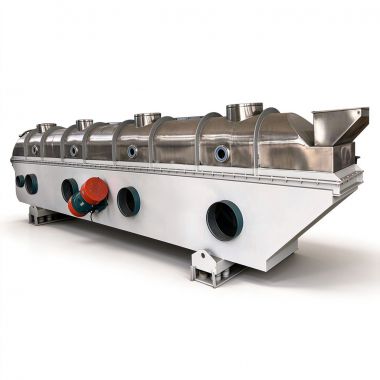


Description: Process technology using gas or liquid flow to suspend solid particles so particles behave like fluid media. Widely applied in chemical processing, power generation, environmental protection and aquarium filtration.
Fluidization onset: Up flowing fluid (gas / liquid) passes upward through solid particle bed. When flow rate exceeds critical fluidization velocity, particles suspend and the whole bed exhibits fluid like characteristics.
Stages with increasing flow velocity: Fixed bed → Bubbling bed → Turbulent bed → Fast fluidized bed → Pneumatic conveying.
• Shell: Upright cylindrical vessel with enlarged top disengaging section.
• Gas distribution plate: Critical component to achieve uniform gas distribution.
• Heat exchange assembly: Internal tube bundle or external jacket for process temperature control.
• Gas solid separator: Cyclone separator is commonly deployed to recover fine solid particles.
• Internals: Baffles, screens to break Large size gas bubbles.
Advantages
1. High heat transfer efficiency; easy to maintain uniform bed temperature.
2. Permits continuous solid material feed & discharge.
3. Supports continuous catalyst regeneration and cyclic operation.
4. Broad fuel adaptability, low NOₓ emission.
Disadvantages
1. Limited operating flexibility; narrow usable flow rate window.
2. High solid particle loss risk; fine powders are easily entrained away.
3. Large equipment footprint and relatively high manufacturing cost.
4. Sophisticated control system required; operation complexity higher compared with Fixed bed systems.

 Contact Us