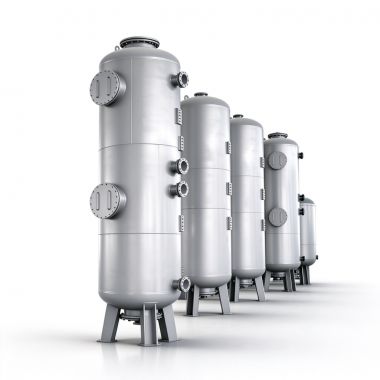

Description: Cylindrical pressure vessel performing ion exchange reactions. Water softening, substance separation and purification are achieved via ion exchange between solution and internally filled ion exchange resin.
Active functional groups on resin capture target ions from solution while releasing equivalent charge counterions.
Basic workflow: feed solution enters one end, flows through compact resin bed; target ions are adsorbed onto resin; treated effluent discharges from opposite end.
Regeneration cycle: After resin adsorption saturation, regenerant (acid / alkali / salt solution) is injected to elute captured ions, restoring resin exchange capacity for cyclic reuse.
Separation principle for chromatography: Different ions show variable resin affinity. Adjust mobile phase pH or salt concentration to realize sequential ion elution and separation.
Assembly consists of pressure vessel column, resin bed, inlet/outlet distributors and regeneration system.
Column Body Materials
• Laboratory setup: Glass / acrylic for visual observation of resin status.
• Industrial setup: Stainless steel lined with rubber / PFA (Teflon) or FRP, suitable for high pressure & strongly corrosive service.
Classification
1. By ion function: Cation exchange column (adsorb positive ions e.g. sulfonic acid groups); Anion exchange column (adsorb negative ions e.g. quaternary ammonium groups).
2. By operation mode: Fixed bed (stationary resin); moving bed (periodic spent resin discharge); Fluidized bed (suspended circulating resin).
3. By regeneration location: In situ regenerated mixed bed; ex situ regenerated mixed bed; anion resin external regeneration mixed bed system.
1. water treatment: Boiler water softening, high purity water preparation, heavy metal removal from wastewater.
2. Biopharmaceutical: Separation & purification for proteins, nucleic acids and antibiotics.
3. Food chemical industry: Sugar desalting, additive analysis, organic acid separation.

 Contact Us