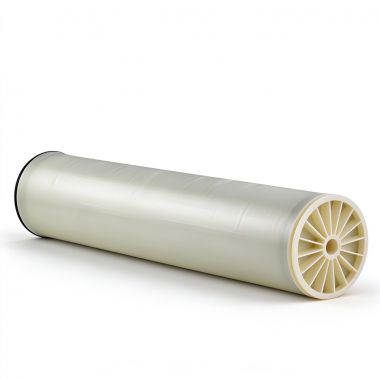


Description: Manmade semipermeable membrane for Reverse Osmosis water purification. Driven by applied pressure, it allows water molecules to pass while retaining salts, bacteria and contaminants. Extremely small pore size (~0.1 nm) effectively separates dissolved substances from feedwater.
Filtration Mechanism Pressure driven Reverse Osmosis: Natural osmosis moves water from low concentration to high concentration side.
Reverse Osmosis applies external pressure to force water molecules from high concentration feed solution (seawater/tap water) towards the low concentration permeate side to produce purified water.
Selective separation: Polyamide composite layer on membrane surface is hydrophilic to permit fast water molecule passage while repelling inorganic ions.
Colloids and high molecular weight organics.multi-layer composite construction: Commercial RO membranes adopt three-layer composite structure: polyester nonwoven support layer.
Polysulfone microporous intermediate layer and ultrathin polyamide separation layer balancing mechanical strength and filtration performance.
Application Fields
1. Household Water Purifiers: Removes scale (calcium magnesium ions) heavy metals and microorganisms for direct drinking purified water.
Industrial & Municipal: Boiler feedwater softening electronics industry ultra pure water production food beverage water treatment and municipal wastewater reuse.
Seawater Desalination: Global mainstream seawater desalination technology salt rejection rate above 5% lower energy consumption than traditional distillation.
Pharmaceutical & Medical: Pharmaceutical grade water production biological agent separation & concentration to satisfy high purity & sterility requirements.
Selection & Maintenance Key performance indexes:.
Salt rejection Rate: Salt removal capability; premium grade membranes >99% rejection.
Permeate Flow Rate: Water output per unit time, selected according to real world water demand.
Fouling Resistance: Wastewater/heavily polluted feedwater requires antifouling or antioxidation coated membrane elements.
Service Life: Household elements: 1–3 years.
Industrial elements: 3–5 years, subject to raw water quality and operation maintenance practice.

 Contact Us