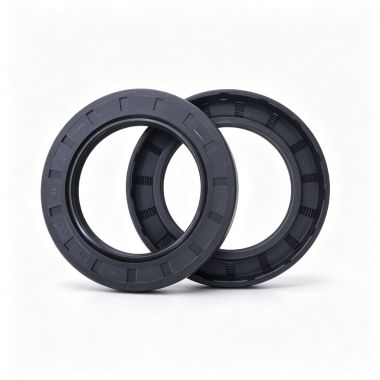


Description: Oil seals usually refer to rotary shaft lip seals in the mechanical field. Their core function is to prevent lubricating oil leakage and block the entry of external dust. They are widely used in rotating equipment such as automobiles, construction machinery, and motors.
The core function of an oil seal is to isolate the parts that require lubrication from the external environment.
The normal operation of the equipment.
Automotive: Used at engine crankshafts, camshafts, gearboxes, differentials, shock absorbers, and axles. Industrial equipment: used in hydraulic motors.
Centrifugal pumps construction machinery wind turbine gearboxes and all kinds of rotating shaft sealing applications.
Home appliances and agricultural machinery: Also common on small and medium-sized equipment such as motors water pumps.
And farm machinery. Types.
TC type: Double-lip with inner skeleton, fully rubber-covered and spring-loaded; good dust and leakage protection.
The most commonly used.
SC type: Single-lip with inner skeleton, a relatively simple structure.
TB/TA type: Rigid metal casing, for high-load or high-speed applications.
VC/KC/DC types: Variants respectively having a single lip without spring a double lip without spring and a double lip with double springs.
Material Selection. Nitrile butadiene rubber (NBR): Oil- and abrasion-resistant, for -40 to 120°C, and low cost.
Fluororubber (FKM): Resistant to high temperature and corrosion, for -30 to 200°C, with better performance but higher cost.
Silicone rubber: Excellent high- and low-temperature performance, for -60 to 250°C.

 Contact Us