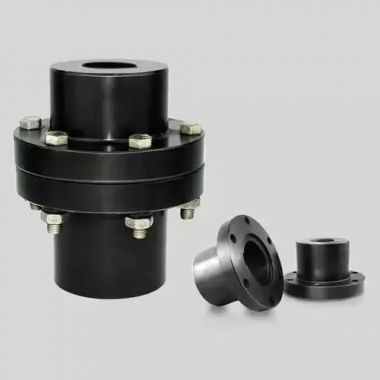


Description: A flange coupling (also known as a flanged coupling) is a rigid coupling that transmits power between shafts by bolting together two flanged disc-shaped half-couplings, each keyed to its own shaft. It comes in two designs: the reamed-hole bolt type, in which the bolts transmit torque in shear, and the shouldered-and-grooved type, in which torque is transmitted by friction at the mating faces. The material is usually gray cast iron or carbon steel, with cast or forged steel for heavy-duty applications.
Introduction This coupling complies with GB/T 5843–2003 and includes three models: GY, GYS, and GYH. The material has been upgraded to 35# steel.
And the bolts are uniformly grade It offers a simple structure low manufacturing cost and high transmission accuracy.
But requires strict alignment of the two shafts and has no capacity to compensate radial axial or angular displacement.
It is for shaft connections with steady loads, steady speeds, and high transmission accuracy requirements.
Special model: The GT type rigid flange coupling is designed specifically to connect a reducer shaft extension to the agitator shaft extension of a reactor.
And can join two shafts of different diameters.
Installation Requirements and Scenarios Flange couplings are for shaft connections with steady loads steady speeds.
And high transmission accuracy requirements such as high-speed drives for pumps compressors and generators. The following points should be noted during installation and use:1. Alignment requirements: The alignment of the two shafts must be strictly controlled.
Relative displacement will impose additional load and cause vibration and noise.
Installation steps: Ensure the axial and radial position accuracy of the flanges keep the two flange faces parallel.
And tighten the bolts evenly to reduce skewing.from other couplings: Compared with flexible couplings such as spider-type or tire-type couplings.
A flange coupling has no elastic element and cannot absorb shock or compensate radial axial or angular displacement.
But it offers higher transmission accuracy and a simpler structure.

 Contact Us