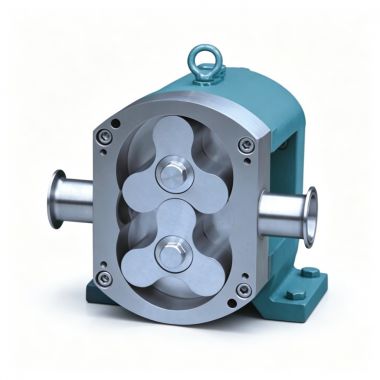
Description: A cam rotor pump (also known as a cam pump or a two-lobe/three-lobe rotor pump) has a pair of rotors driven by an external timing gear to rotate synchronously in opposite directions. Under normal conditions the rotors do not touch each other, and a small clearance is maintained between the rotors and the pump casing or liner, the medium being conveyed by the change in volume. Rotors fall into two main types: integral metal rotors and rubber-coated rotors. They are the core flow-through component and an important wear-prone part.
Function
1. The two rotors rotate in opposite directions and change the volume of the pump chamber: negative pressure forms at the inlet to draw in the medium.
And the medium is squeezed out at the outlet with positive-displacement conveying. Dividing the pump chamber into closed conveying cavities determines the displacement and volumetric efficiency of the pump.
As the rotors wear, the clearance increases, internal backflow rises, and flow rate and pressure decrease. Rubber-coated rotors rely on their elasticity and can run dry briefly, with good self-priming.
Metal rotors have poor self-priming. They resist erosion by the medium, friction from particles, and chemical corrosion, and transmit the output torque of the gearbox.
Classification
1. By Lobe Profile.
Two-lobe rotor: Strong particle-handling capability for sludge and slurry with large particles but with slightly greater pulsation.
Three-lobe rotor: Low flow pulsation and stable operation; for general chemical and food applications.
Spiral rotor: The lowest pulsation, for shear-sensitive materials. By Major Material① Rubber-coated rotor (metal skeleton plus outer vulcanized rubber) The skeleton is usually 304/316L stainless steel.
And the outer layer is rubber. NBR (nitrile butadiene rubber): For oily wastewater and general sludge; ≤80–90°C.
Not resistant to strong solvents. EPDM (ethylene propylene diene monomer): For hot water, weak acids and alkalis, and food applications.
Not resistant to mineral oil.
FKM fluororubber: Resistant to oil, acids and alkalis, and solvents; resistant to high temperature, but expensive.
Silicone rubber: Food and pharmaceutical grade. Good elasticity, resistant to particles, and able to run dry briefly.
Drawbacks: the rubber swells, ages, and debonds.② Integral metal rotor. 304/316L stainless steel: Food grade and general chemical grade, and CIP-cleanable.
2205 duplex steel: For chloride-ion and mildly corrosive conditions. Tungsten carbide (WC) surface coating: For highly abrasive conditions containing particles.
Greatly extends wear life, but is expensive. Metal rotors do not touch each other and rely on clearance for sealing.
In particulate service the tips and outer edges of the rotors are prone to erosion and wear.③ Special rotorCeramic rotors are extremely wear-resistant and chemically resistant and are mostly used in high-end fine chemicals.
But they are very expensive. Problems (Symptoms) Rubber-Coated Rotor
1. Wear and chipping of the rubber surface: The rubber at the outer edge and lobe tips is eroded and peeled away by particles.
The flow rate drops.
Rubber swelling: The medium is incompatible with the rubber so the outer diameter of the rotor increases the current rises.
And in severe cases the pump seizes. Hardening and cracking of the rubber: Overheating and aging produce surface cracks.
And rubber debris is carried along in the material. Debonding (the rubber separating from the metal skeleton): The rubber bulges and forms hollow spots.
The pressure fluctuates, abnormal noise occurs, and efficiency falls rapidly. Plastic deformation of the rotor lobe tips: Pressure buildup or jamming by foreign matter causes permanent deformation of the rubber.
Metal Rotor
1. Erosion and wear of the lobe tips and outer edges: The clearance increases the pump discharge becomes insufficient.
And internal leakage increases. Pitting and corrosion pits: Corrosion by the medium produces pockmarks and pits on the surface.
Impact notches and grooves: Hard foreign objects entering the pump chamber cause mechanical damage. Rotor deformation and imbalance: Impact overload increases operating vibration and aggravates damage to the liner and seals.
Causes of Damage
1. Incorrect material selection: Chemical incompatibility between the rubber and the medium causes swelling and cracking.
While metal is not resistant to corrosion by the medium; this is the most common cause of early failure of rubber rotors.
Abrasion by hard particles in the medium: Sand and impurities continuously cut the rotor surface; excessive speed accelerates wear, so the speed should be reduced for media with a high solids content.
Foreign matter entering the pump chamber: Welding slag metal blocks and hard debris lodge in the pump chamber chipping the rubber and denting the metal rotor.
Overheating: Exceeding the permissible temperature of the rubber accelerates aging, hardening, and cracking. Outlet pressure buildup and overpressure: A blocked outlet creates an excessive pressure differential and hence excessive squeezing stress on the rotor.
Deforming the rubber and fatiguing the metal. Prolonged dry running: Rubber rotors may only run dry briefly; prolonged idling generates frictional heat that burns and debonds the rubber.
Timing gear failure: Excessive gear clearance or broken teeth make the two rotors collide and interfere with each other.
Directly damaging them. Manufacturing process defects: Poor vulcanization and bonding of rubber rotors causes the rubber to come away in service.
While metal rotors may have material defects or insufficient machining accuracy.
Installation problems: Misalignment causes abnormal loading on the drive shaft and additional load on the rotor.
Increasing wear and vibration. Points of Operation and Maintenance
1. When a rubber rotor fails, check the pump chamber liner (wear plate) at the same time.
A damaged liner will in turn accelerate rotor wear. If the metal rotor shows obvious erosion grooves or impact dents, grinding and repairing it for further use is not recommended.
Key points in spare parts selection: lobe type (two-lobe/three-lobe) material profile dimensions and shaft-end connection type.
With replacement in pairs. Rubber rotors should be stored away from light and heat to stop premature aging of the rubber.



 Contact Us