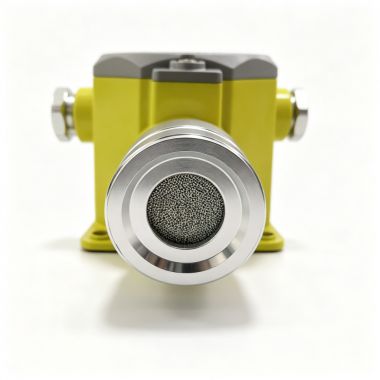


Description: A hydrogen alarm monitors the concentration of hydrogen (H₂) in the air. When the concentration exceeds the limit it gives an audible and visual alarm and can also be interlocked with an explosion-proof fan or a shut-off solenoid valve to prevent hydrogen explosions. It is widely used in hydrogen production stations, hydrogen refueling stations, lithium battery workshops, hydrogen cylinder rooms, laboratories, and battery rooms.
Fixed type (the industrial mainstream): detector (probe) plus alarm controller
Detector: An on-site explosion-proof probe that measures the hydrogen concentration; hazardous areas require an explosion-proof rating of Ex d IIC T6.
Alarm controller: A central control unit that displays the concentration, records alarms, and outputs relay interlock signals, and can be connected to DCS/PLC/GDS systems.
Portable hydrogen detectors are also available; inspection personnel carry them for on-site leak detection. They are pump-suction or diffusion type and provide audible, visual, and vibration alarms.
Catalytic combustion type (most commonly used): Measures the % LEL (lower explosive limit) with a fast response, suitable for combustible-gas monitoring; however, it is easily poisoned by silicon and sulfur gases, with a service life of 3-5 years.
Electrochemical: ppm trace detection with good selectivity; suitable for screening trace leaks, with a service life of generally 2-3 years.
Infrared: Resistant to poisoning and stable, but relatively costly; suitable for harsh, corrosive conditions.
Lower explosive limit LEL = 4% Vol
Level 1 low alarm: 25% LEL = 1% Vol (10,000 ppm); warning and ventilation activated.
Level 2 high alarm: 50% LEL = 2% Vol (20,000 ppm); strong alarm, gas supply shut off, and personnel evacuated.
Hydrogen is lighter than air, so leaks rise upward:
The probe should be installed 0.5-2 m above the leak source, close to the ceiling. Do not install it at an air outlet or air-conditioning vent, where airflow dilution can cause missed detection.
The controller is installed near the ground at a height of 1.5 m for easy viewing.
Dead corners at the top of enclosed rooms should be key monitoring points; wiring in hazardous areas must use explosion-proof twisted-pair cable with sealed explosion-proof connections.
Normal environment: Calibrate at least once a year; in humid, dusty, or corrosive environments, calibration every six months is recommended.
Inspect regularly and clean the probe dust cover; sensors have a limited life and must be replaced when it expires, and cannot be used indefinitely.
It is strictly forbidden to open the detector housing while it is energized in an explosion-proof area.
Immediately cut off the hydrogen supply.
Start the explosion-proof exhaust ventilation; do not switch ordinary electrical appliances, switches, mobile phones, or use open flames, so as to prevent ignition sources.
Evacuate personnel to a safe area upwind.
Ventilate to displace the gas, and wait until the concentration falls back to a safe value before tracing the leak.
Industrial sites involving hydrogen require explosion-proof certification and CCC fire-protection certification.
Measuring range: Normally 0-100% LEL
Signal: 4-20 mA / RS485 Modbus / M-BUS two-wire bus
Whether interlocking of fans, emergency shut-off valves, and remote IoT alarms is required
Distinguish between fixed online monitoring and portable inspection leak detection.

 Contact Us