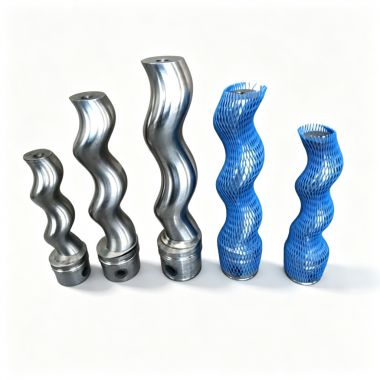
Description: For single screw pumps (PCP) only; two-screw and three-screw pumps use metal screw rotors and have a different structural logic. The rotor is a single-helix external metal shaft that meshes with the double-helix rubber stator in planetary eccentric rotation, forming the core working pair of the pump together with the stator.
Function
1. Together with the stator cavity it forms a series of continuous sealed volume chambers and the medium is conveyed as it moves axially with the chambers.
Its eccentric rotation squeezes the rubber lining of the stator to build up conveying pressure. It transmits the torque from the universal joint and withstands the scouring, friction, and corrosion of particles in the medium.
The interference of the rotor-stator pair determines the volumetric efficiency of the pump: excessive interference causes high current and rapid wear.
While insufficient interference causes large internal backflow and inadequate flow and pressure.
Materials and Surface Treatment The substrate is usually carbon steel or stainless steel and wear and corrosion resistance is provided by a surface plating or coating:1. 45# steel substrate with hard chrome plating: For general working conditions such as sewage and sludge.
The most cost-effective option; not resistant to strong corrosion and the plating peels off easily on impact.304 stainless steel with hard chrome: For mildly corrosive and food-processing conditions.316L stainless steel with hard chrome: For weakly acidic and weakly alkaline corrosive media.316L with sprayed tungsten carbide (WC): For high-particle and highly abrasive conditions.
Wear resistance far exceeds that of chrome plating, but the cost is high.
Duplex steel 2205: For highly corrosive media; it can be chrome plated or coated with sprayed tungsten carbide.
A bare metal rotor is rarely used as is; wear protection comes mainly from the coating. Once the coating is damaged, the substrate is quickly eroded.
Classification
1. By number of helices: The vast majority are single-helix rotors (matched with a double-helix stator).
A few high-flow, low-pressure units use multi-helix rotors.
By pressure stage: Single-stage, two-stage, and four-stage; the rotor length increases with the number of stages.
By surface treatment: chrome-plated rotor, tungsten-carbide-sprayed rotor, and ceramic-coated rotor.
By connection type: spline connection, square-head connection, and pin connection (matched to the universal joint).
Problems and Symptoms
1. Coating wear and peeling: Scratches and pits appear on the surface; the pump flow rate drops and the pressure becomes insufficient, accelerating wear of the stator rubber.
Scoring and grooves on the rotor surface: Hard particles or foreign matter in the medium become lodged producing grooves on the helical surface.
Bending and deformation of the rotor: Abnormal eccentric loading; abnormal noise during operation; and severe one-sided wear of the stator.
Corrosion spots and pitting: The medium is corrosive, so once the coating is damaged the substrate rusts and pits.
Fracture at the end or spline wear: Torque impact or universal joint failure causes the spline at the drive end of the rotor to wear round or even fracture.
Localized burning and discoloration: When the pump runs dry the high temperature generated by friction tempers and discolors the rotor surface.
Causes of Damage
1. Abrasion by particles in the medium: Sand and hard impurities trapped between the rotor and stator continuously cut into the coating.
Making this the most common cause of wear. Dry running or idling: Without the lubrication and cooling of the medium.
Friction causes a sharp rise in temperature that burns out the plating and quickly destroys the stator. Coating quality defects: Insufficient chrome thickness and poor adhesion cause flaking and peeling during operation.
Mechanical damage caused by universal joint failure: Broken universal joint pins or excessive clearance make the rotor travel abnormally.
Causing impact bending and localized uneven wear. Corrosion by the medium: Once the coating is damaged the base metal comes into direct contact with corrosive material and pits.
And the pits further scratch the stator rubber. Overpressure and pressure buildup: The outlet is blocked and the pressure differential exceeds the limit.
So the squeezing stress between rotor and stator becomes excessive and wear is aggravated. Poor installation alignment: Misalignment between the pump body and the reducer subjects the rotor to additional lateral force.
Causing localized wear. Foreign matter entering the pump chamber: Welding slag metal blocks and hard debris get in and directly strike or score the helical working surface.
Points of Operation and Maintenance
1. When replacing the stator, be sure to check the surface condition of the rotor.
If the rotor has scratches or peeling plating, the new stator will wear out quickly. If the rotor has obvious grooves or large areas of plating have come off.
Grinding and repairing it for further use is not recommended; it should be replaced. Key selection criteria: helix size, overall length, connection type, base material, and surface coating type.
The rotor and stator form a matched friction pair; if one is damaged, it must be assessed whether the other should be replaced at the same time.



 Contact Us